




Acceptance and Commitment Therapy: Australian Trauma Guide
- Claire Cashman
- Jul 26
- 12 min read
Updated: 4 days ago
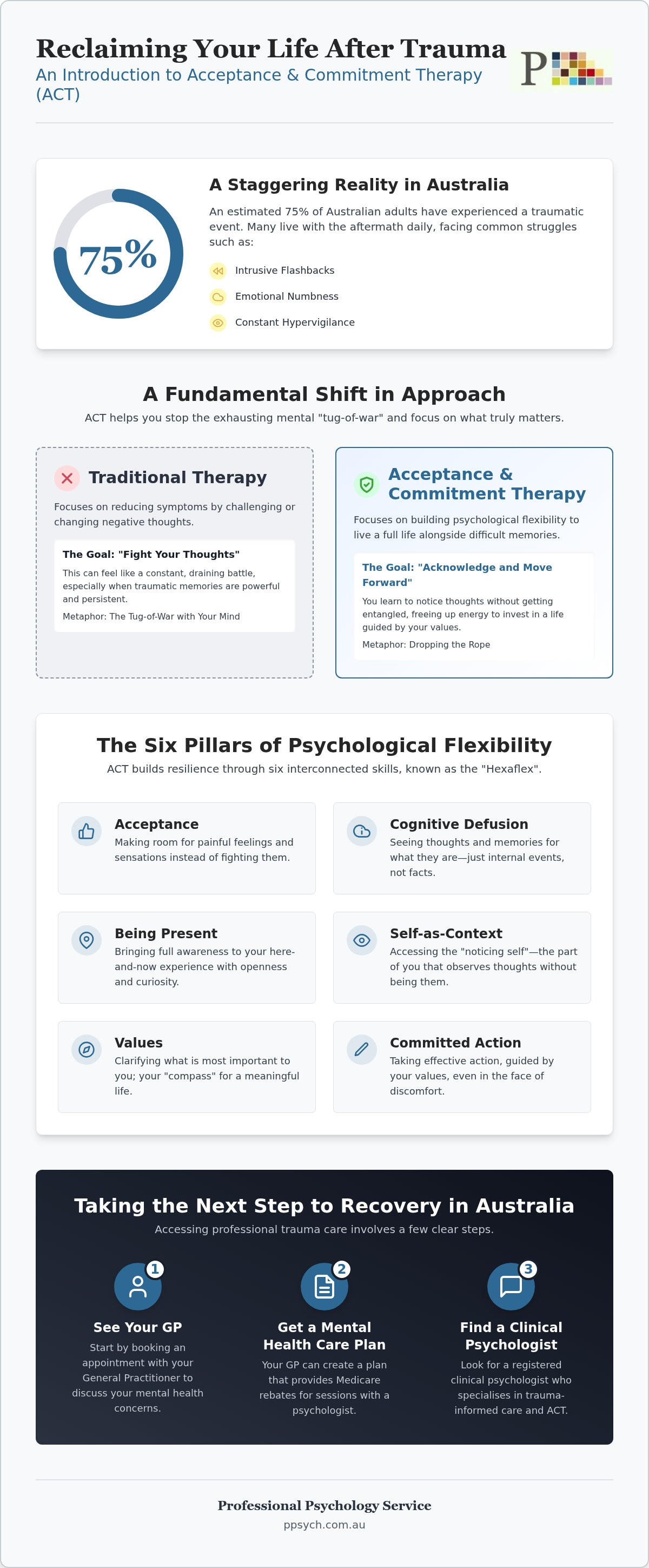
Did you know that an estimated 75% of Australian adults have experienced a traumatic event in their lifetime? It is a staggering figure that underscores a painful reality: many of us are carrying the heavy weight of the past every single day. You might find yourself trapped by intrusive flashbacks, feeling emotionally numb, or constantly on edge, making it difficult to feel truly present in your own life or connected to those you love.
It's exhausting to live in a state of constant hypervigilance, but there is a way to move forward. Discover how Acceptance and Commitment Therapy (ACT) provides a compassionate, evidence-based pathway to reclaiming your life after trauma. Rather than trying to delete the past, act therapy for trauma helps you build the psychological flexibility needed to live a full life alongside your history. This guide explores how you can reduce the power of traumatic memories and gain practical tools for emotional regulation, allowing you to engage deeply with the world once again.
Table of Contents
What is Acceptance and Commitment Therapy (ACT) for Trauma?
Acceptance and Commitment Therapy (ACT) is a modern, evidence-based branch of psychological care that sits within the broader family of Cognitive Behavioural Therapy (CBT). While traditional approaches often focus on reducing or eliminating symptoms, Acceptance and Commitment Therapy (ACT) prioritises a concept known as psychological flexibility. This involves the ability to stay present and conscious in the moment, regardless of how difficult it feels, and taking action that aligns with your deepest personal values. It is a practical, action-oriented model that helps you stop fighting your own mind.
When we discuss act therapy for trauma, the word "acceptance" is frequently misunderstood. It doesn't mean you have to like what happened, excuse the person who hurt you, or simply "get over it." Instead, acceptance is the active process of acknowledging the reality of your internal experiences, such as memories or physical sensations, without letting them control your life. Traditional talk therapy can sometimes leave survivors feeling stuck in a cycle of searching for the "why" behind their pain. ACT shifts the focus from the past to the present, helping you create a rich and meaningful life even while managing the echoes of trauma.
How ACT Views the Traumatic Experience
In the ACT model, trauma isn't viewed as a broken part of your identity that needs fixing. Instead, the aftermath of trauma is seen as a collection of internal barriers, including intrusive thoughts, painful emotions, and distressing body sensations, that currently prevent you from living a life you value. The focus isn't just on the traumatic memories themselves, but on your relationship with those memories. By changing how you interact with your history, you can reduce its power to dictate your future. In trauma recovery, the concept of workability refers to whether your current way of responding to pain is actually helping you move toward a life that feels vital and purposeful.
The Difference Between ACT and Traditional CBT
Standard CBT often encourages people to "challenge" or "change" their negative thoughts to something more realistic. For many trauma survivors, this can feel like an exhausting, never-ending tug-of-war with their own brain. ACT teaches you to "drop the rope" in that struggle. You don't need to win the argument with your thoughts to move forward; you just need to recognise that a thought is simply words or a picture in your mind. This non-combative approach is often safer for survivors because it avoids the frustration of trying to control uncontrollable internal events, allowing you to focus your energy on healing and growth instead.
The Six Core Pillars of ACT in Trauma Recovery
In the clinical setting, practitioners often use a framework called the "Hexaflex" to guide the recovery process. This model isn't just a collection of theories; it's a set of six practical skills designed to build psychological resilience. At a professional psychology clinic, these pillars are used to help you move from a state of being "stuck" in your past to being actively engaged in your present. Each pillar targets a specific symptom of trauma, such as the avoidance that keeps your world small or the hypervigilance that keeps you exhausted.
While many Australian trauma support programs provide essential safety and stabilisation, act therapy for trauma goes a step further by teaching you how to change your relationship with pain. These skills require practice, much like learning a new language or a physical craft. Over time, they weave together to create a stable anchor, allowing you to navigate emotional storms without being swept away.
Cognitive Defusion and Mindful Presence
Trauma often causes "fusion," where a person becomes so entangled with a thought that it feels like an absolute truth. For instance, the thought "I am unsafe" can feel like a physical reality even in a secure environment. Cognitive defusion involves stepping back and seeing thoughts as just words or images. A common exercise is "leaves on a stream," where you imagine placing each distressing memory on a leaf and watching it float by. This doesn't make the memory disappear, but it stops it from being the only thing you can see. When combined with mindful presence, these tools help manage dissociation by gently grounding you in the "here and now."
Values and Committed Action
Trauma has a way of stealing your sense of future. Identifying your values acts as a compass, helping you decide what kind of person you want to be despite what has happened. Values aren't goals you check off a list; they are ongoing directions for your life, such as being a supportive friend or a creative person. Committed action is the process of taking small, manageable steps toward those values. Even on days when emotional numbness feels heavy, taking one tiny action aligned with your values can provide a sense of agency and purpose that trauma once took away.
Self-as-Context: The Observing Self
One of the most profound gaps in traditional trauma care is the failure to address the "broken" sense of self. Self-as-context teaches you that you are the "container" for your experiences, not the experiences themselves. Think of yourself as the sky and your traumatic memories as a dark, passing storm. The storm may be intense, but it cannot hurt the sky. By connecting with this "observing self," you can separate your core identity from the traumatic event. This creates a deep sense of internal safety, as you realise there is a part of you that remains whole and unchanged by the past. If you feel your identity has been swallowed by your history, reaching out to a clinical psychologist for trauma and PTSD treatment can help you reconnect with this enduring part of yourself.
Why ACT is Highly Effective for PTSD and Complex Trauma
Many survivors feel they are in a constant battle with their own memories. In the ACT model, this is often described through the metaphor of the "Struggle Switch." When this switch is "on," you fight against your anxiety, flashbacks, or numbness, which inadvertently creates a layer of secondary suffering. It is like being caught in quicksand; the more you struggle to escape the emotional weight, the deeper you sink into exhaustion. By learning to turn the switch "off," you don't necessarily stop the initial pain of the trauma, but you stop the additional, draining fight against it.
The Acceptance and Commitment Therapy evidence base shows that this approach is particularly effective because it doesn't just aim for symptom reduction. While many traditional models focus on feeling "less bad," act therapy for trauma focuses on living "more good." This shift toward vitality and personal purpose is a hallmark of post-traumatic growth. It allows you to move forward without waiting for every trace of your past to vanish first. Engaging in professional trauma and ptsd treatment within a clinical setting ensures that these transitions are managed safely by experts who understand the nuances of complex presentations.
Breaking the Cycle of Experiential Avoidance
Experiential avoidance is the natural human urge to stay away from painful thoughts, feelings, or memories. While it feels like a survival strategy, trying not to think about a trauma often makes it more persistent and intrusive. ACT teaches "willingness," which isn't about liking the pain, but about creating space for it so it no longer consumes your entire life. Acceptance reduces the physiological impact of triggers because the body isn't constantly bracing for a fight it can't win. This willingness expands your "life space," allowing you to go places and do things you might have previously avoided.
The Role of Self-Compassion in Healing
Trauma often leaves a heavy legacy of shame and self-blame. You might feel "broken" or "weak" for how you reacted during or after the event. ACT integrates self-compassion to soften this harsh inner critic. It helps you shift the narrative from "What is wrong with me?" to a more validating "What happened to me?" This gentle perspective is essential for healing. It allows you to approach your own recovery with the same kindness and patience you would offer a dear friend in a similar situation.
Practical Strategies: What to Expect in an ACT Session
Entering a session for act therapy for trauma can feel like a significant shift from traditional talk therapy. The process is active and collaborative. Your clinical psychologist will begin with an initial assessment that looks beyond just your symptoms. While understanding your history is important, identifying your core values is equally vital. We explore what truly matters to you, as these values become the foundation for your recovery. Together, you'll engage in collaborative goal setting to define what a meaningful life looks like for you. This might involve returning to social activities, pursuing a career goal, or simply feeling more present at home.
Instead of just talking about your problems, you'll participate in experiential exercises. These often involve metaphors and mindfulness practices designed to give you a direct experience of psychological flexibility. Throughout this process, safety and pacing are the highest priorities. A qualified clinical psychologist ensures the work moves at a speed you can manage, preventing you from feeling flooded or overwhelmed. If you're ready to begin this journey, you can book a clinical consultation to discuss a personalised plan.
Safe Exposure: 'Dipping In and Out'
Unlike some older methods that might lead to re-traumatisation through "flooding," ACT uses a more gentle approach. This technique involves briefly touching on difficult memories while staying firmly grounded in the present moment. Think of it as dipping your toe into a cold pool rather than jumping into the deep end. The goal is to become more flexible with these memories. You learn that you can acknowledge their presence without letting them dictate your current behaviour or emotional state.
Building Your Toolkit for Daily Life
Recovery doesn't just happen in the therapy room. You'll build a practical toolkit of "on-the-spot" grounding techniques to use when triggers occur in your daily life. Your psychologist may suggest homework, such as practising defusion or mindfulness in real-world situations. This helps you integrate your new skills into your routine. For those managing professional responsibilities, SA Business Coaching can provide additional guidance on leading a business with purpose. When difficult emotional waves hit, you can use your values as a compass to make decisions that lead toward growth, rather than just reacting to the pain of the past.
Taking the Next Step: Accessing Trauma Care in Australia
Deciding to seek professional support is a courageous step toward reclaiming your life. In Australia, the mental health system is designed to support this journey, but it can sometimes feel complex to navigate while you are already managing the weight of the past. For complex trauma, a doctorate-level clinical perspective is vital. Clinical psychologists undergo extensive university training and supervised practice to understand the intricate ways trauma affects the brain and body. This high level of expertise ensures that act therapy for trauma is delivered with the precision and safety required for deep, sustainable healing. This focus on safety and risk assessment is equally relevant in professional contexts, where EC Risk & Assurance provides high-end health, safety, and risk consulting to help organisations maintain secure and compliant environments.
Because the body often stores the physical weight of stress and trauma, many people find that integrating gentle wellness support from livelovelifechiropractic.com.au can be a valuable way to address the somatic side of recovery alongside psychological therapy.
In addition to clinical therapy, some people benefit from the practical, one-on-one mentorship of a Sober Coach, which provides professional recovery support and workshops to help you stay committed to your goals outside of the clinical environment.
Additionally, reducing everyday stressors by keeping your essential communication tools functional can support your focus on healing; for those in North Lakes, Platinum Phone Repair provides expert technical assistance to ensure you stay connected to your support systems.
Your first point of contact is usually your General Practitioner (GP). When you book your appointment, it is helpful to request a longer consultation to discuss a Mental Health Care Plan. You can be direct with your GP about your interest in Acceptance and Commitment Therapy. Understanding the intersection of trauma recovery and medicare is essential for managing the practical side of your care. This system exists to ensure that evidence-based psychological support is accessible and subsidised for all Australians, providing a stable anchor during your recovery.
Navigating the Medicare Mental Health Care Plan
To access subsidised sessions, you'll need to follow a specific pathway. First, visit your GP to obtain a Mental Health Care Plan (MHCP) and a referral letter. This plan allows you to claim a rebate for up to 10 individual sessions per calendar year. It is important to distinguish between clinical psychologists and generalist counsellors, as the titles are regulated differently in Australia. Clinical psychologists provide the highest tier of Medicare rebates, reflecting their advanced postgraduate training. As of July 2026, the Medicare rebate for a standard consultation with a clinical psychologist is $145.25 per session.
Preparing for Your First Consultation
Your first session is an opportunity to ensure the practitioner is a good fit for your needs. Don't hesitate to ask specific questions about their experience with ACT and trauma recovery. You might ask how they manage session pacing or what their approach is to ensuring you feel grounded during difficult conversations. When you attend, bring your referral letter, your MHCP, and a brief summary of your history and goals. Remember that recovery is a steady, methodical journey rather than a quick destination. With the right clinical guide and a commitment to your personal values, you can build a future that is no longer defined by the events of your past.
Building a Life Beyond the Past
Recovery is rarely a straight line, but it's a path you don't have to walk alone. By shifting your focus from a constant struggle with the past to a steady commitment to your personal values, you can begin to experience life with greater vitality and presence. We've explored how the core pillars of the Hexaflex provide a practical framework for this growth, allowing you to manage difficult memories without being defined by them.
Choosing the right professional support is essential for this deep, clinical work. At Professional Psychology Service, our doctorate-level clinical psychologists are registered with the Psychology Board of Australia and hold specialist expertise in trauma and PTSD. We provide a stable, evidence-based anchor for those seeking act therapy for trauma. If you're ready to take the next step toward a more meaningful life, you can begin your recovery journey with a clinical consultation at Professional Psychology Service. Your history is a part of you, but it doesn't have to be the end of your story.
Frequently Asked Questions
Is ACT therapy better than CBT for trauma and PTSD?
ACT isn't necessarily "better" than traditional Cognitive Behavioural Therapy (CBT), but it offers a different, non-combative alternative. While CBT focuses on challenging and changing negative thoughts, ACT teaches you to change your relationship with them. Many Australians find this approach more sustainable because it doesn't require "winning" an argument with your brain. It's about learning to live a full life even when difficult memories are present.
Will I have to relive my trauma in detail during ACT sessions?
You don't have to recount every painful detail of your history to benefit from this approach. ACT prioritises your current relationship with those memories rather than the narrative of the past. We use grounding exercises to ensure you stay safe in the present moment while addressing the internal barriers that keep you stuck. This prevents the "flooding" or re-traumatisation often feared in traditional trauma work.
How many sessions of ACT are usually needed for trauma recovery?
Treatment length is personal and depends on your specific history and goals. Some individuals find significant relief within 10 sessions, while complex cases might require a longer-term commitment. Your clinical psychologist will regularly review your progress to ensure the therapy remains effective and aligned with the values you've identified for your recovery. This methodical approach ensures you aren't rushed through your healing.
Can children and adolescents benefit from ACT for trauma?
Children and adolescents can certainly benefit from ACT through the use of creative metaphors and age-appropriate exercises. It teaches them that they are more than their thoughts and feelings, which is a vital lesson for young survivors. This builds a foundation of resilience that helps them navigate the challenges of growing up after experiencing a traumatic event, focusing on their potential for growth. In school settings, hearing from a dedicated youth mental health speaker like Jeff Yalden can further reinforce these principles of resilience and self-worth for students.
Is ACT an evidence-based treatment recognised in Australia?
ACT is a gold-standard, research-backed treatment that is fully recognised by major Australian health organisations. It is a key component of act therapy for trauma due to its strong evidence base and clinical efficacy. Numerous peer-reviewed studies confirm its ability to reduce the impact of PTSD symptoms and significantly improve the overall quality of life for survivors across the country.
What if I find it too difficult to 'accept' my traumatic past?
Acceptance is often the most misunderstood part of the process. It isn't about approval, liking, or forgiveness; it's about acknowledging that the event occurred so you can stop the exhausting internal tug-of-war. If acceptance feels impossible right now, your psychologist will help you work on "willingness" instead. This is a smaller, more manageable step toward making room for your internal world without letting it control you.
Can I get a Medicare rebate for ACT therapy sessions?
You are eligible for Medicare rebates for these sessions if you have a valid Mental Health Care Plan. Your GP can provide this referral during a standard consultation, which allows you to claim rebates for up to 10 sessions per year. Clinical psychologists offer the highest tier of rebates in Australia, which helps make high-quality, doctorate-level trauma treatment more accessible for those who need it.
How do I find a clinical psychologist who specialises in ACT?
Start by asking your GP for a specific referral to a clinical psychologist with expertise in act therapy for trauma. You can also search the AHPRA register to verify a practitioner's credentials and clinical endorsement. It's important to choose someone who has extensive experience in trauma-informed care and doctorate-level training to ensure you feel safe and supported throughout your recovery journey.


Comments