




Acceptance and Commitment Therapy for Depression
- Claire Cashman
- Jul 27
- 13 min read
Updated: 6 hours ago
What if the key to managing depression isn't about fighting your darkest thoughts, but rather changing how you relate to them? If you've spent years trying to "fix" or suppress your low mood, you likely know how exhausting that struggle can be. It's common to feel stuck in a cycle of negative thinking, where the effort to feel better only seems to lead to further frustration. This is where act therapy for depression offers a different path. Instead of viewing your emotions as enemies to be defeated, this approach focuses on building psychological flexibility, allowing you to move through life's challenges with more resilience.
You may be feeling confused by the different therapy options available or simply tired of the weight depression places on your daily routine. We understand that finding a way forward requires both clinical expertise and genuine compassion. In this guide, you'll discover how Acceptance and Commitment Therapy provides a research-backed framework to help you embrace your experiences while living a life led by your personal values. We'll examine the core pillars of ACT, provide practical tools for handling difficult emotions, and show you how to reduce the impact of depressive symptoms on your day-to-day life.
Table of Contents
What is ACT Therapy for Depression?
Acceptance and Commitment Therapy (ACT) is a modern, evidence-based form of clinical psychology that has changed how we approach major depressive disorder. While many people believe the goal of therapy is to eliminate "bad" thoughts, act therapy for depression suggests that our struggle to get rid of these feelings is often what keeps us stuck. It's a subtle but profound shift in perspective. Instead of focusing solely on symptom suppression, ACT aims to help you get better at feeling, so you can focus on getting better at living.
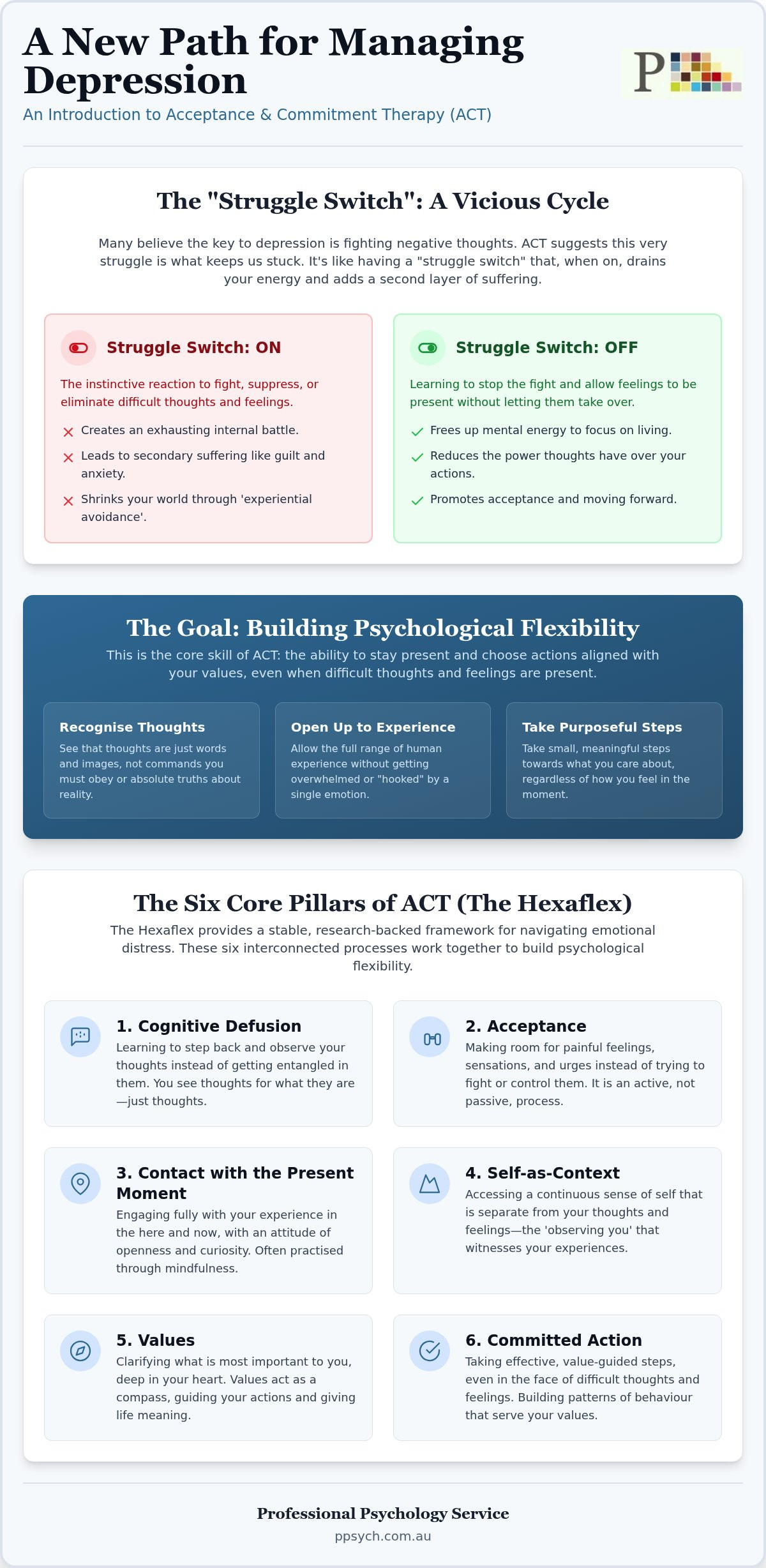
One of the most helpful ways to understand this is through the "struggle switch" concept. When a wave of low mood or a self-critical thought hits, your natural instinct is to flip the switch to "on" and fight it. You might tell yourself you shouldn't feel this way or try to force a more positive outlook. This internal battle usually creates a secondary layer of suffering, such as guilt or anxiety about being depressed. By learning to flip that switch to "off", you aren't saying you enjoy the pain. You're simply stopping the fight, which frees up the mental energy you need to move forward.
The Shift from Avoidance to Acceptance
Many individuals living with depression find themselves trapped in a pattern called experiential avoidance. This involves turning away from uncomfortable thoughts, memories, or social situations to find temporary relief. While it feels like a survival strategy, it often makes your world feel smaller and more restricted. Act therapy for depression encourages a move toward acceptance. This isn't about resignation or "giving up". It's a clinical rationale for acknowledging your current internal state so that it no longer has the power to block your progress.
Why Psychological Flexibility Matters
At the core of this framework is psychological flexibility. This is the ability to stay present in the moment, even when it's difficult, and choose actions that align with your personal values. Depressive thinking is often characterised by "rigidity", where you feel you can't engage with life until your mood improves. Flexibility breaks this cycle by teaching you to:
Recognise that thoughts are just words and images, not absolute truths that must be obeyed.
Open up to the full range of human experience without becoming overwhelmed or "hooked" by a single emotion.
Take small, purposeful steps toward the things you care about, such as your family or your career, regardless of how you feel in that exact moment.
This approach transforms your relationship with depression. It moves you from being a passive observer of your symptoms to an active participant in a life that feels meaningful and purposeful.
The Six Core Pillars of the ACT Model
To understand how act therapy for depression works in practice, we look to a framework known as the Hexaflex. This clinical model organises six core processes that work together to dismantle the "depressive trap." It's helpful to view these pillars not as abstract theories to study, but as practical skills to be practised daily. When depression takes hold, it often creates a sense of mental rigidity. The Hexaflex provides a structured way to regain your psychological movement by focusing on these six areas:
Cognitive Defusion: Learning to step back from thoughts.
Acceptance: Making room for painful feelings instead of fighting them.
Contact with the Present Moment: Engaging fully with the "here and now."
Self-as-Context: Accessing a sense of self that is separate from your emotions.
Values: Clarifying what truly matters to you.
Committed Action: Taking effective steps based on those values.
These pillars are interconnected. By strengthening one, you naturally support the others. For many, Acceptance and Commitment Therapy offers a stable anchor because it doesn't demand that you "fix" your depression before you can start living. Instead, it provides a toolkit to help you carry your experiences more lightly. Working with an experienced clinical psychologist can help you tailor these pillars to your own circumstances, ensuring the approach feels relevant to your life.
Mindfulness and Being Present
In the context of act therapy for depression, mindfulness is quite different from general relaxation or meditation. It isn't about trying to feel calm or clearing your mind of all activity. Instead, it's about "Contact with the Present Moment." Depression often pulls the mind into a heavy cycle of rumination, where you might find yourself stuck replaying past mistakes or worrying about a bleak future. Grounding techniques, such as noticing five things you can see or feel in the room, help pull you out of that mental loop and back into the physical world where life is actually happening.
Cognitive Defusion: Stepping Back from Thoughts
When you're depressed, negative self-talk can feel like an absolute, undeniable truth. You might feel as though you "are" your depression. Cognitive defusion is the process of seeing thoughts as bits of language rather than objective facts. This shift allows you to recognise that having a thought like "I'm useless" is simply an event in your mind, not a reflection of your reality. By creating this small amount of distance, the thought loses its authority over your behaviour, leaving you free to choose your next move based on what you value rather than what your depression dictates.
ACT vs. CBT: A Different Approach to Depressive Thoughts
Cognitive Behavioural Therapy (CBT) has long been considered a gold standard in clinical psychology. It's a highly effective modality that focuses on identifying and challenging the "cognitive distortions" that fuel low mood. However, many people find that despite their best efforts to think more rationally, their negative thoughts remain persistent. If you've ever felt frustrated because you "can't change your negative thoughts," you aren't alone. This is precisely where act therapy for depression offers a refreshing alternative. Instead of teaching you how to debate with your mind, ACT focuses on changing your relationship with those thoughts.
While CBT often seeks to modify the content of what you think, ACT changes the context in which those thoughts occur. It's a shift from "fixing" to "observing." For individuals managing complex mental health histories, including those who may be seeking trauma and ptsd treatment, this less confrontational approach can feel much more manageable. It removes the pressure to perform "perfect" mental hygiene and instead invites you to carry your history with more compassion and less struggle.
Content vs. Context
Think of your depressive thoughts like a radio playing in the background of a room. In a traditional CBT framework, the goal might be to change the station or argue with the announcer to prove they're wrong. In act therapy for depression, we acknowledge the radio is playing, but we don't try to turn it off. We simply change the context. You can choose to leave the radio playing while you focus on something else, like a conversation with a friend or a task at work. By not arguing with your own mind, you stop giving the "radio" the power to dictate your day. This approach is often particularly useful for chronic or treatment-resistant depression, where the "noise" of the mind has become a constant companion.
Values-Based Living vs. Symptom Reduction
A key difference in the ACT model is what we measure as success. While most therapies focus heavily on symptom reduction, ACT prioritises "what you do" rather than just "how you feel." The paradox of this approach is that when you stop obsessing over whether or not you feel depressed and start focusing on your values, your symptoms often begin to lift as a natural byproduct. Success isn't defined by the absence of sadness, but by the presence of meaningful action. This focus on value-led living builds a type of long-term resilience that extends far beyond a single depressive episode, providing you with a reliable compass for the future.
Practical ACT Therapy Techniques for Everyday Life
In the framework of act therapy for depression, the most vital question you can ask yourself isn't "is this thought true?" but rather "is this thought workable?" Workability is a clinical concept that examines whether a particular thought or belief helps you move toward the life you want to lead. For example, the thought "I'm too tired to go for a walk" might be factually true in the moment, but if acting on it keeps you isolated and stagnant, it isn't workable. Learning to evaluate your internal dialogue based on its helpfulness rather than its accuracy is a significant step toward recovery.
One of the most effective ways to build this skill is through cognitive defusion exercises. When a harsh self-criticism arises, try this three-step process to reduce its impact:
Identify the negative thought, such as "I am a failure."
Reformulate the sentence by adding a prefix: "I am having the thought that I am a failure."
Add a further layer of distance: "I notice I am having the thought that I am a failure."
This simple shift in language reminds you that you are the observer of your thoughts, not the thoughts themselves. If you're ready to explore these tools in a structured environment, our clinical psychology services provide a supportive space to begin your recovery.
The 'Leaves on a Stream' Exercise
This classic mindfulness technique is a cornerstone of act therapy for depression. It involves closing your eyes and imagining a gently flowing stream with leaves floating on the surface. As each thought, feeling, or memory enters your mind, place it on a leaf and watch it float past. The goal isn't to make the leaves move faster or to clear the stream, but to practise non-judgmental observation. During a depressive peak, the stream might feel like a rushing waterfall. If this happens, don't try to stop the water. Simply acknowledge the intensity of the flow and continue to watch from the bank, recognising that even the most violent rapids eventually settle.
Identifying Your Core Values
Depression often clouds our sense of purpose, making it difficult to remember what we once cared about. To find your way back, it helps to distinguish between goals and values. A goal is a destination you can reach and tick off a list, such as "getting a new job." In contrast, values are chosen qualities of being and acting that guide us through life. They are like a compass; you never "arrive" at North, but North always tells you which way to walk. To uncover your values, ask yourself: "If I weren't so weighed down by these feelings, what kind of friend or partner would I choose to be?"
The final stage of this journey is committed action. This involves taking small, manageable steps that align with your values, even when your mood is low. It might be as simple as sending a single text to a loved one, spending five minutes in the garden, or beginning a creative project. If your values lead you toward writing, you might check out Soul Scriptz to see how they help authors turn manuscripts into professionally published books. These actions, however small, prove that your depression does not have the final say in how you live your life.
Starting Your ACT Journey with a Clinical Psychologist
While self-help techniques offer a valuable starting point, engaging in act therapy for depression with a clinical psychologist provides the structured support needed to navigate complex mental health challenges. A professional setting ensures that the principles of the Hexaflex aren't just concepts you understand intellectually, but tools you can apply effectively to your unique circumstances. Our doctorate-led team brings a high level of clinical authority to this process, ensuring that every session is grounded in established, research-backed methodology. This methodical approach helps to lower the anxiety often associated with starting therapy, providing a stable anchor as you begin to explore new ways of relating to your emotions.
The Role of the Clinical Psychologist
Choosing a clinical psychologist means you're working with a professional who has undergone extensive training and is fully registered with the Psychology Board of Australia. This level of expertise is particularly beneficial when depression is compounded by other factors, such as grief or high-pressure career demands. For women whose mental health is also influenced by hormonal changes, working with a Women’s Mental Health Specialist can provide the virtual, hormone-informed care necessary for a more holistic recovery. A senior clinician provides a safe, non-judgmental space where difficult internal states can be acknowledged without being alarmist. Through regular supervision and a commitment to evidence-based practice, they ensure that your care remains consistent and high-quality. This relationship is built on quiet strength and patience, allowing you to move at a pace that feels intentional rather than rushed.
Medicare and Accessing Care in Australia
Accessing professional support in Australia is a straightforward process designed to lower the barriers to mental health care. The first step involves visiting your GP to discuss your concerns and request a Mental Health Care Plan. This plan allows you to access Medicare rebates for your sessions, making clinical psychology more accessible. It's also worth noting that Medicare telehealth flexibilities have been extended through to December 2027, which means you can often receive support from the comfort of your own home if that feels more manageable. For more information on navigating the referral process, you can read our guide on trauma recovery and medicare.
Taking that first step toward value-led living is a brave choice. By working with a professional who understands the nuances of ACT, you gain a compassionate guide who is dedicated to your long-term resilience. Services such as Citizen Coaching and Counselling provide specialised therapeutic support online, while clinicians looking to further their expertise can discover Martin Hogg (Private Practice Success) for accredited CPD training and business coaching. You don't have to wait for your depression to disappear before you start building a life that feels meaningful. With the right clinical support, you can begin to move through the fog and reconnect with the things that truly matter.
Reclaiming Your Life Through Value-Led Living
ACT represents a fundamental shift from trying to "solve" depression to learning how to live a rich, meaningful life alongside difficult emotions. By focusing on psychological flexibility and the six core pillars of the Hexaflex, you can reduce the impact of painful thoughts and refocus your energy on what truly matters. This approach doesn't promise the immediate absence of sadness; instead, it offers a way to ensure that sadness no longer dictates your daily choices. It's about building a life that feels purposeful, even when the path is challenging.
If you're ready to move beyond the cycle of internal struggle, act therapy for depression provides a stable, research-backed framework for recovery. Our doctorate-led clinical practice offers evidence-based treatment pathways designed to help you navigate this transition with confidence. All our clinicians are fully registered with the Psychology Board of Australia, providing the professional expertise and steady support you need to move forward. You don't have to wait for the fog to lift before you start moving toward a life that reflects your deepest values.
Book a consultation with our Clinical Psychologists to explore ACT for depression. Support is available to help you find your way back to the things you care about most.
Frequently Asked Questions
Is ACT therapy better than CBT for depression?
Neither approach is objectively superior; instead, they offer different pathways to recovery. While CBT focuses on identifying and changing the content of negative thoughts, act therapy for depression focuses on changing your relationship with those thoughts. Some individuals find the ACT approach more sustainable if they feel exhausted by the constant effort of trying to "fix" or "challenge" their internal dialogue.
How many sessions of ACT therapy are usually needed for depression?
The duration of therapy depends on your individual circumstances and the complexity of your symptoms. Many people begin to see meaningful progress within 8 to 12 sessions as they establish the core skills of the Hexaflex. Long-standing or treatment-resistant depression may require a more extended period of clinical support to ensure these new habits are fully integrated into your daily life.
Can I practise ACT therapy techniques on my own?
You can certainly use mindfulness and defusion exercises independently to manage daily stress. However, working with a clinical psychologist is highly recommended for structured progress. A professional can help you identify subtle patterns of experiential avoidance that are often difficult to spot on your own, ensuring you apply the techniques in a way that truly supports your long-term recovery.
What is the 'Acceptance' part of ACT therapy? Does it mean giving up?
Acceptance is a conscious choice to make room for difficult feelings rather than fighting them. It is not the same as resignation or giving up. By stopping the internal battle against your symptoms, you free up the mental and emotional energy needed to take purposeful action. It's about acknowledging your current reality so you can move forward with more clarity and less struggle.
Is ACT therapy covered by Medicare in Australia?
Yes, act therapy for depression is an evidence-based treatment covered under the Better Access initiative. To access Medicare rebates for your sessions, you'll first need to visit your GP to obtain a Mental Health Care Plan. This plan allows you to receive professional support from a registered clinical psychologist while significantly reducing your out-of-pocket expenses for a set number of sessions per year.
Can ACT therapy be used alongside medication for depression?
ACT is frequently used in conjunction with medication prescribed by a GP or psychiatrist. While medication can help stabilise the biological aspects of low mood, therapy provides the psychological tools required to change behavioural patterns. This combined approach often leads to better outcomes, as it addresses both the physical symptoms and the mental strategies needed for a value-led life.
How do I know if ACT is the right fit for my personality?
This approach often resonates with people who feel tired of "forced positivity" or feel stuck in a cycle of overthinking. If you prefer practical, action-oriented strategies and are open to exploring mindfulness, ACT may be a good fit. It's particularly helpful for those who want to focus on what they can do now, rather than waiting to feel "perfect" before they start living.
Does ACT therapy involve talking about my past or childhood?
ACT is primarily a present-focused and future-oriented therapy. While your clinical psychologist may discuss your past to understand how certain thought patterns developed, the goal isn't to dwell on history. Instead, you'll focus on how those past experiences show up in the "here and now" and learn how to prevent them from dictating your future choices and actions.


Comments