




ACT for Anxiety: Guide to Psychological Flexibility
- Claire Cashman
- Jul 25
- 13 min read
Updated: 3 days ago
What if the exhausting struggle to "fix" your anxious thoughts is actually what keeps you stuck in them? For many Australians, the traditional approach to mental health involves a constant battle to suppress or eliminate worry, yet this often leads to more fatigue. Acceptance and commitment therapy for anxiety offers a different path by teaching you that you don't need to win the war against your feelings to live a rich life. This evidence-based approach focuses on building psychological flexibility, helping you carry your internal experiences more lightly while moving toward what truly matters.
It's incredibly draining to feel like your life is on hold until your anxiety finally disappears. You've likely tried every trick to calm your mind, only to find the "noise" returns the moment you step outside your comfort zone. In this guide, you'll discover how ACT provides a research-backed framework to transform your relationship with difficult emotions and reclaim your sense of purpose. We'll explore the core pillars of this therapy, provide practical tools for handling intrusive thoughts, and show you how to re-engage with your values even when things feel uncertain.
Table of Contents
Understanding ACT for Anxiety: Shifting the Clinical Focus
Acceptance and Commitment Therapy (ACT) represents a significant evolution in clinical psychology. Unlike traditional models that aim to reduce or eliminate symptoms, ACT is a mindfulness-based behavioural therapy designed to help you change your relationship with your internal experiences. It suggests that the primary cause of suffering isn't the presence of anxious thoughts themselves, but our attempt to avoid or control them. This clinical shift moves the focus from "feeling better" to "living better," even when uncomfortable feelings arise.
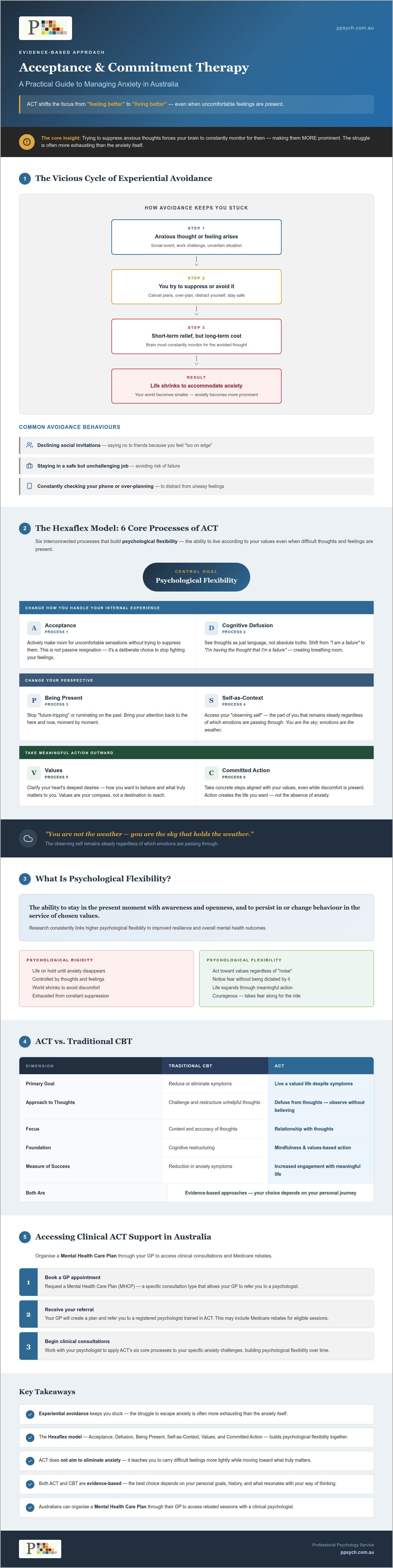
When you try to suppress a thought, your brain must constantly monitor for that thought to ensure it isn't happening. This paradox, often called the "pink elephant" effect, means that the more energy you spend fighting anxiety, the more prominent it becomes in your awareness. Acceptance and commitment therapy for anxiety teaches that this struggle is often more exhausting than the anxiety itself. It invites you to stop the tug-of-war with your mind so you can use that energy for things that actually matter to you.
The Problem with Avoidance
Experiential avoidance occurs when we try to escape or push away difficult sensations, thoughts, or memories. While avoiding a stressful social event provides immediate relief, the long-term cost is a life that feels increasingly small and restricted. Clinical practice shows that this habitual avoidance is often the root of anxiety persistence. The struggle to stay safe from our own feelings becomes the very thing that prevents us from doing what we truly value. You might find yourself:
Declining invitations to see friends because you feel "too on edge."
Staying in a job that doesn't challenge you to avoid the risk of failure.
Constantly checking your phone or over-planning to distract from uneasy feelings.
In the ACT model, we say "the struggle is the problem." By trying to avoid the "bad" feelings, we inadvertently cut ourselves off from the "good" ones too. This creates a cycle where your world shrinks to accommodate your anxiety, rather than your anxiety fitting into a larger, meaningful life.
Defining Psychological Flexibility
Psychological flexibility is the ability to stay in the present moment with awareness and openness, and to persist in or change behaviour in the service of chosen values. It's the skill of noticing your fear without being dictated by it. By developing this flexibility, you gain the capacity to take meaningful action toward your goals, regardless of whether your mind is currently "quiet" or "noisy." Research consistently links higher levels of psychological flexibility to improved resilience and overall mental health outcomes. It isn't about being fearless; it's about being courageous enough to take your fear along for the ride while you drive toward the life you want.
The Hexaflex Model: Six Core Processes of ACT
To understand how acceptance and commitment therapy for anxiety works, clinicians look to a framework called the "Hexaflex." This model consists of six core processes that function like gears in a machine. When these gears turn together, they create psychological flexibility. This isn't a linear checklist; rather, it's a set of interconnected skills that help you stay grounded when your mind starts to race. The goal is to move from a state of being "hooked" by your thoughts to a state of open awareness.
The first two processes, Acceptance and Cognitive Defusion, change how you handle your internal weather. Acceptance is often misunderstood as passivity or "giving up." In a clinical sense, it's actually an active choice to make room for uncomfortable sensations without trying to suppress them. Cognitive Defusion then helps you see thoughts as just language or mental events, rather than absolute truths. Instead of thinking "I am a failure," you learn to notice, "I'm having the thought that I'm a failure." This small shift creates the space needed to breathe.
The next two processes, Being Present and Self-as-Context, focus on your perspective. Being present helps you stop "future-tripping" or ruminating on the past, bringing your attention back to the here and now. Self-as-Context involves accessing the "observing self," the part of you that remains steady and unchanged regardless of which emotions are passing through. It's the difference between being the weather and being the sky that holds the weather.
Values and Committed Action
The final pieces of the Hexaflex turn your focus outward. Values are your heart's deepest desires for how you want to behave and what you want to stand for. They aren't "goals" that you can tick off a list; instead, they're ongoing directions, like north on a compass. While a goal might be "getting a new job," the underlying value might be "professional growth" or "contribution." Committed action is the process of taking concrete steps toward those values, even when anxiety is present. It's about doing what matters, even if you have to take your fear along with you.
For many Australians, these values extend into their professional lives. If managing business finances is a source of stress, you can learn more about creditte to see how their accounting and advisory services can support your committed action toward business success.
Mindfulness in a Clinical Context
In acceptance and commitment therapy for anxiety, mindfulness is far more than just sitting in quiet meditation. It's an active, functional skill used to reduce the power of rumination and help you engage with your life. Our senior clinicians at Professional Psychology Service guide you through these practices to ensure they're integrated into your daily routine. This structured approach helps you build a toolkit that works in the middle of a stressful workday, not just in a quiet room. If you feel ready to develop these skills with professional guidance, you might consider how a clinical consultation can help you apply the Hexaflex model to your specific needs.
ACT vs. Traditional CBT: Choosing Your Path
Choosing between therapeutic modalities can feel overwhelming, but it's helpful to know that both Cognitive Behavioural Therapy (CBT) and ACT are evidence-based, high-quality clinical approaches. While they share a common goal of improving mental health, their methods of handling anxious thoughts differ fundamentally. Traditional CBT is often described as a "top-down" approach. It focuses on identifying irrational or unhelpful thoughts and using logic to challenge and replace them with more balanced perspectives. If your mind tells you something catastrophic will happen, a CBT approach helps you look at the evidence to see if that's actually true.
In contrast, acceptance and commitment therapy for anxiety doesn't aim to change the content of your thoughts. Instead, it changes your relationship with them. If you've ever felt that your anxiety is "sticky", meaning you know your worries are irrational but they persist anyway, ACT may offer the breakthrough you need. It suggests that you don't need to win a debate with your mind to move forward. This approach is particularly effective for chronic or persistent anxiety where logic has already failed to provide lasting relief.
When is CBT More Appropriate?
CBT remains highly effective for specific cognitive distortions where a person can clearly identify a "glitch" in their logic. It's excellent for short-term, targeted problem-solving. For instance, if a person has a specific phobia or a very clear pattern of catastrophic thinking, CBT's structured evidence-testing can provide rapid relief. There is also a powerful synergy between trauma and PTSD treatment and these cognitive modalities, as they help individuals regain a sense of safety by re-evaluating their environment and internal narratives.
The Unique Benefits of the ACT Approach
One of the most significant advantages of ACT is that it reduces the exhaustion associated with constant cognitive monitoring. Many people find that trying to "reframe" every negative thought into a positive one feels like a full-time job. ACT allows you to step off that treadmill. It helps you build a life that feels authentic and grounded, regardless of the "internal weather" you're experiencing on any given day. This approach is particularly helpful for those who find traditional "positive thinking" feels invalidating or superficial. By using acceptance and commitment therapy for anxiety, you learn to acknowledge the reality of your pain without letting it dictate your actions or diminish your quality of life.
This focus on living well despite difficult emotions is a key feature of modern psychotherapy, and organisations like Benessere Marriage and Family Therapy, Inc help individuals and families apply these principles to achieve a more purposeful life.
Practical ACT Techniques for Managing Anxious Thoughts
Moving from the theory of the Hexaflex into daily life requires the development of specific psychological skills. These are not "quick fixes" designed to make your anxiety vanish instantly; rather, they're tools to help you change how much power those thoughts have over your actions. By regularly using these techniques, you can begin to unhook yourself from repetitive cycles of worry. While you can practise these independently, many people find that working with a professional is essential for applying acceptance and commitment therapy for anxiety to deeply ingrained patterns.
It's important to view these strategies as skills that require repetition, much like training a muscle. The more you use them during moments of low stress, the more accessible they become when your anxiety is high. These exercises focus on creating a gap between the thought and the reaction, allowing you to choose how you want to behave regardless of what your mind is saying.
Cognitive Defusion Exercises
Defusion is the skill of stepping back from your thoughts to see them for what they are: just words and images. One effective technique is the "I am having the thought that..." method. Instead of saying "I am going to fail," try saying, "I am having the thought that I am going to fail." This simple addition creates a necessary layer of distance. Another powerful tool is "Naming the Story." When you notice a familiar loop of anxiety, label it. You might say, "Ah, here is the 'I'm-not-good-enough' story again." By categorising the thought, you reduce its authority. Finally, try thanking your mind for its contribution. When your mind provides a dire warning, simply say, "Thank you, mind, for trying to protect me, but I've got this." This prevents you from getting into a debate with your own brain.
Acceptance and Expansion
Acceptance involves making room for the physical sensations of anxiety rather than tightening up against them. You can begin by performing a brief body scan to locate where the anxiety lives, perhaps as a knot in the stomach or a racing heart. Once you've located the sensation, imagine breathing into and around it, creating "space" for it to exist. This is the process of expansion. Instead of trying to evict the feeling, you're simply allowing it to be there. The "Guest House" metaphor is often used here; view your emotions as temporary visitors. You don't have to like the guest, and you don't have to agree with them, but you can allow them to sit in the room while you continue with your day. If you find these sensations overwhelming, you can book a clinical consultation to develop a personalised plan for managing them safely and effectively.
Accessing Clinical ACT Support in Australia
Starting a formal programme for acceptance and commitment therapy for anxiety is a significant commitment to your long-term wellbeing. In Australia, the process is structured to ensure you receive evidence-based care from qualified professionals. Most people begin by visiting their General Practitioner to discuss their mental health concerns. Your GP can then assess your needs and, if appropriate, prepare a Mental Health Care Plan. This document is essential for accessing Medicare rebates and provides a clear pathway for your clinical journey.
Professional Psychology Service offers these clinical consultations nationally, providing a stable and supportive environment for your recovery. During your initial session, your psychologist will focus on understanding your unique experiences with anxiety and identifying what you hope to achieve. This is a collaborative space where you can speak openly, knowing you're being heard by an expert who is dedicated to your progress. It's a time to set the foundation for a relationship built on trust and clinical expertise.
Medicare and Fees for Clinical Psychology
Medicare rebates significantly reduce the out-of-pocket costs for evidence-based therapies like ACT. Clinical psychologists, who often hold doctorates and have extensive training, are specifically recognised by the Australian healthcare system for their ability to deliver these complex interventions. This ensures that the support you receive is grounded in the latest psychological research and ethical standards. For a more comprehensive look at how these financial supports work, you can read our Medicare and Psychology guide.
Beginning Your Journey with Professional Psychology Service
Led by Dr Claire Cashman, our team of senior clinicians specialises in the implementation of ACT for complex mental health needs. We provide a professional and compassionate setting where you can move beyond simply managing symptoms. Our environment is designed to be a steady anchor, offering the quiet strength and patience required for meaningful change. We understand that the path to resilience is personal, and we're here to guide you through every step of developing your psychological flexibility.
Our goal is to help you build the skills required to lead a truly values-driven life. You don't have to wait for your anxiety to disappear before you start living with purpose. By engaging with acceptance and commitment therapy for anxiety, you're choosing to reclaim your life from the cycle of worry. We invite you to reach out and begin the process of re-engaging with what matters most to you, supported by a team that values your growth and integrity.
While many of these resources are specific to the Australian healthcare system, those living overseas can also find dedicated support. For example, Prague Integration offers specialised therapy services designed for the expatriate community, helping individuals maintain their mental wellbeing while navigating life in a new country.
Reclaiming Your Life Beyond Anxiety
Building psychological flexibility is a journey of shifting your focus from the internal struggle toward the things that bring meaning to your life. By moving away from the exhaustion of trying to eliminate every worry, you create the space needed to breathe and grow. You've explored how acceptance and commitment therapy for anxiety provides the clinical tools to unhook from repetitive loops and engage with the present moment. Whether you're practising defusion or identifying your core values, these skills serve as a reliable anchor during turbulent times.
Professional guidance ensures these strategies are applied effectively to your specific needs. At Professional Psychology Service, our team of clinical psychologists with doctoral-level expertise is dedicated to providing evidence-based trauma and anxiety specialist care. We are fully registered with the Psychology Board of Australia, ensuring a high standard of clinical integrity and safety. You can book a clinical consultation with our experienced psychologists to begin your transition toward a values-driven life today. It's possible to carry your feelings with you while you move toward a more purposeful future.
Frequently Asked Questions
What is the difference between ACT and CBT for anxiety?
Traditional CBT focuses on identifying and challenging the content of "irrational" thoughts to replace them with more balanced ones. Acceptance and commitment therapy for anxiety takes a different path by changing your relationship with your thoughts rather than trying to fix them. Instead of debating whether a worry is true, you learn to notice it as a mental event that doesn't have to dictate your actions or your day.
Is ACT an evidence-based treatment for social anxiety?
Yes, ACT is a research-backed, evidence-based treatment for social anxiety. Clinical studies show that it's highly effective for helping people re-engage with social activities by building psychological flexibility. Rather than waiting for the fear of judgement to disappear, you learn to carry that feeling while acting in accordance with your social values. This often leads to more authentic connections and a broader, more meaningful social life.
How long does Acceptance and Commitment Therapy take to work?
The timeframe for progress depends on your individual needs and the complexity of your situation. Many people begin to notice a significant shift in how they handle their thoughts within 6 to 12 sessions. Because ACT is a skills-based therapy, the focus is on equipping you with practical tools you can use for a lifetime. Your psychologist will work with you to set a steady pace that feels both manageable and effective.
Does Medicare cover ACT sessions in Australia?
Yes, Medicare provides rebates for acceptance and commitment therapy for anxiety when it's delivered by a registered psychologist. To access this financial support, you'll need to organise a Mental Health Care Plan through your GP. This plan allows you to claim a portion of the session fee for a set number of clinical consultations per calendar year. It's a structured way to access high-quality psychological care within the Australian healthcare system.
What are the 6 core principles of ACT?
The ACT model is built on six core processes: Acceptance, Cognitive Defusion, Being Present, Self-as-Context, Values, and Committed Action. These principles function together to help you stay grounded in the moment and take meaningful action toward your goals. By developing these skills, you move from being "hooked" by your anxious thoughts to a state of open, flexible awareness that supports your long-term mental health and resilience.
Can ACT be used for children with anxiety?
Yes, clinicians frequently adapt ACT for children and adolescents. By using age-appropriate metaphors and creative activities, psychologists help younger clients understand their "worry brain" without feeling overwhelmed. The focus is on helping children identify what matters to them, like playing with friends or learning new skills, and teaching them how to take "brave steps" even when they feel uneasy. It's a powerful way to build early emotional resilience, with resources from Balanced Minds Psychology & Wellness illustrating how evidence-based psychology can support students during high-pressure moments like standardised testing.
Is ACT effective for panic attacks?
ACT is very effective for managing panic by changing your response to intense physical sensations. Instead of fighting a racing heart or shortness of breath, you learn to observe these experiences with curiosity and openness. This approach breaks the "fear of fear" cycle that typically fuels a panic attack. By making room for the sensations rather than struggling to suppress them, the intensity and duration of the episodes often decrease over time.
What if I cannot accept my anxiety?
It's completely normal to feel that you can't accept your anxiety, especially when it feels painful or intrusive. In a clinical context, acceptance isn't about liking the feeling or wanting it to stay; it's simply about stopping the exhausting struggle against it. If you find it impossible to accept the anxiety, you can start by accepting the *feeling* of being unable to accept it. This small shift creates the initial space needed for progress.


Comments