




Adult ADHD Treatment Without Medication: A Clinical Guide to Non-Pharmacological Strategies
- Claire Cashman
- Jul 30
- 12 min read
Updated: 1 day ago
What if the most effective way to manage your ADHD wasn't found in a pharmacy, but in the way you intentionally structure your environment and process your emotions? For many adults, the "ADHD tax" is a daily reality that shows up as missed deadlines, forgotten social commitments, or the crushing weight of chronic disorganisation. You might feel like you're constantly running just to stay in the same place, exhausted by the mental load of simple daily tasks. It's a common experience to feel overwhelmed by the demands of life, yet there is a path forward that focuses on building functional resilience.
When searching for an adhd psychologist sunshine coast, many individuals are looking for a stable, research-backed alternative or supplement to traditional treatments. This clinical guide explores evidence-based psychological strategies designed to help you regain focus and improve relationship stability without relying solely on medication. We will examine how specific non-pharmacological tools and environmental scaffolding can reduce your anxiety and provide a clear, methodical roadmap for managing your symptoms. By understanding the mechanics of your mind, you can begin to replace chaos with a sense of quiet confidence and order.
Table of Contents
Why Seek Adult ADHD Treatment Without Medication?
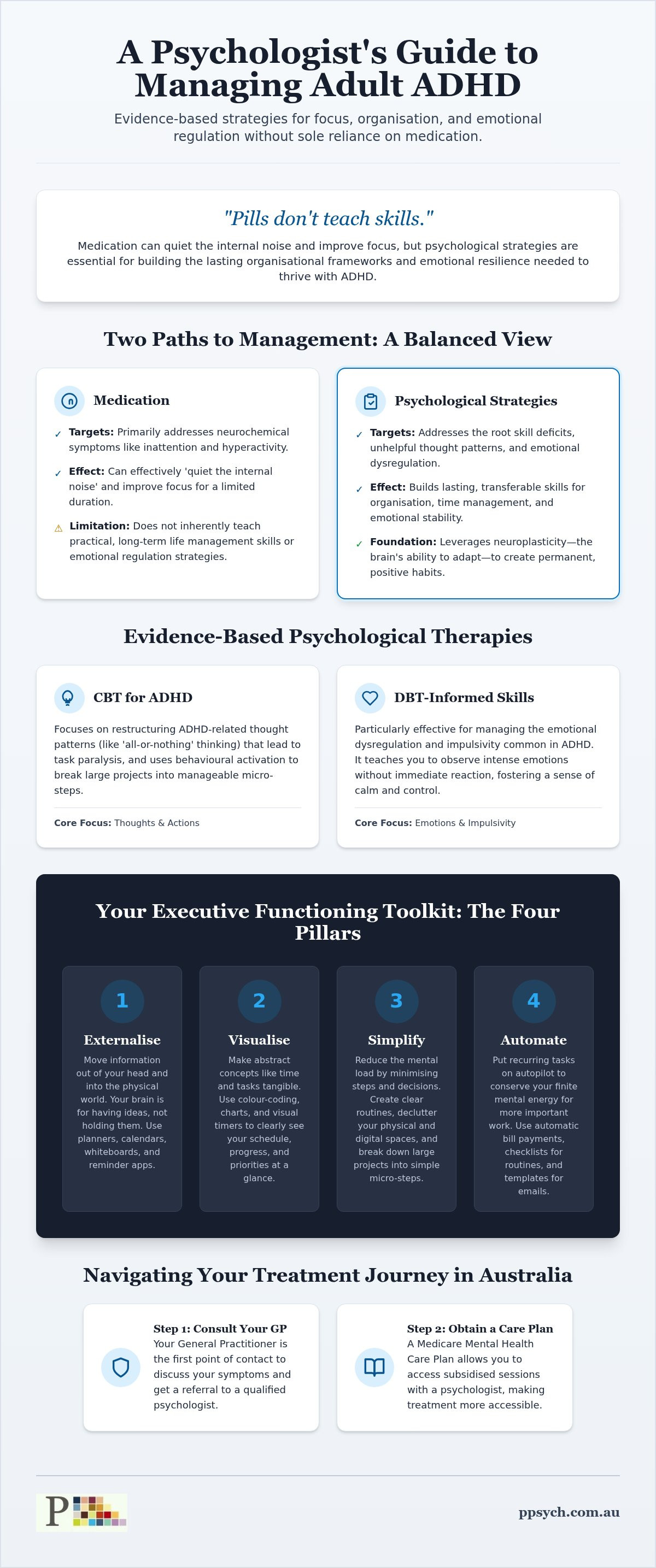
Choosing to manage ADHD without medication is a deeply personal decision, often rooted in a desire for long-term, skill-based autonomy. While pharmaceutical options are widely discussed, they primarily target the neurochemical symptoms of the condition rather than the practical skill deficits that impact daily life. In a clinical setting, we often use the phrase "pills don't teach skills" to highlight this distinction. Medication might quiet the internal noise, but it doesn't provide the organisational frameworks or emotional regulation strategies needed to thrive. For many seeking an adhd psychologist sunshine coast, the goal is to build a toolkit that remains effective even when the biological effects of a tablet have worn off.
The Functional Impact of ADHD in Adulthood
Adult ADHD often looks very different from the childhood stereotype of a restless student. In the Australian context, it frequently manifests as chronic executive dysfunction, affecting your ability to manage a career or maintain stable relationships. You might find yourself struggling with the "ADHD tax," where forgotten bills or missed appointments lead to tangible financial and social costs. This persistent sense of falling short of your potential can lead to an emotional toll characterised by low self-esteem and anxiety. Therapy provides a dedicated space to unpick these patterns, moving away from the label of "underachiever" toward a structured understanding of how your brain functions.
Medication vs. Psychological Intervention: A Balanced View
It's helpful to view Adult attention deficit hyperactivity disorder through a multi-faceted lens where medication is just one possible tool. Psychological intervention focuses on creating permanent cognitive shifts that don't rely on a prescription. Neuroplasticity is the brain's remarkable ability to reorganise itself by forming new neural connections in response to learning and experience. By leveraging this, you can develop habits that eventually become second nature through consistent practice.
This non-pharmacological pathway is particularly well-suited for individuals with mild symptoms, those who experience adverse side effects from stimulants, or anyone who simply prefers a behavioural approach. Working with an adhd psychologist sunshine coast allows you to design a "scaffolded" life, where environmental design and psychological resilience provide a steady anchor. This methodical approach ensures that progress is grounded in evidence-based practice and tailored to your unique life circumstances. It's about building a foundation that supports your growth without the need for chemical intervention.
Evidence-Based Psychological Modalities for ADHD
Clinical psychology stands as the gold standard for individuals seeking to manage ADHD symptoms through non-pharmacological pathways. Unlike generic coaching, a clinical approach uses research-backed frameworks to address the underlying cognitive structures that drive behaviour. It's essential to work with an adhd psychologist sunshine coast who possesses a deep understanding of neurodivergence, ensuring that strategies are tailored to the way your brain actually processes information. A Systematic review of non-pharmacological ADHD interventions confirms that these structured psychological modalities significantly improve functional outcomes and quality of life for adults.
While various therapies exist, Dialectical Behaviour Therapy (DBT) is particularly effective for managing the emotional dysregulation and impulsivity often associated with the condition. It provides a steady anchor for those who feel frequently overwhelmed by intense feelings or sudden shifts in mood. By learning to observe these emotions without immediate reaction, you can gain a sense of control that feels both stable and empowering.
CBT for ADHD: Restructuring Thoughts and Actions
Cognitive Behavioural Therapy (CBT) for ADHD is quite different from standard CBT. It focuses heavily on identifying "ADHD-related" thought distortions, such as all-or-nothing thinking or "comparative despair," where you constantly measure your progress against neurotypical standards. These patterns often lead to task paralysis, a state where the sheer volume of a project feels so insurmountable that you cannot begin. Through behavioural activation, we break these cycles into manageable micro-steps. In cases where ADHD symptoms are complicated by past stressors, this approach naturally integrates with Trauma and PTSD Treatment to address the layers of your experience holistically; practitioners like Susan McGilloway, LCPC offer specialised support for those navigating the intersection of trauma and emotional wellbeing.
Mindfulness and Acceptance-Based Strategies
Acceptance and Commitment Therapy (ACT) is a powerful tool for reducing the deep-seated shame that many adults carry after years of feeling "unproductive." Instead of fighting against your neurobiology, ACT encourages you to accept your brain's unique wiring while committing to actions that align with your values. This is often paired with evidence-based mindfulness to help train the "attention muscle." You don't need to meditate for hours to see results. Implementing micro-mindfulness, such as taking three intentional breaths between meetings or focusing solely on the sensation of your coffee during a break, can ground your nervous system during a hectic Australian workday.
If you're ready to start building these practical skills, our team at Professional Psychology Service offers a methodical and empathetic environment to support your journey. Finding the right adhd psychologist sunshine coast can be the first step toward a more predictable and fulfilling daily life.
Building an Executive Functioning Toolkit
Executive function is frequently described as the brain's "Air Traffic Control" system. It is the sophisticated mental command centre responsible for coordinating focus, managing time, and switching between tasks. For many adults, this control tower feels perpetually understaffed, leading to the chronic disorganisation and overwhelm mentioned earlier. Rather than relying on sheer willpower, which is a strictly finite resource, effective management involves building a "scaffolded" life. By working with an adhd psychologist sunshine coast, you can develop a personalised toolkit that outsmarts your brain's natural tendencies through methodical system design.
A robust management plan is built upon four essential pillars. These pillars shift the burden from your internal mental effort to external systems that provide stability and predictability:
Externalising: Moving information out of your mind and into the physical or digital world.
Visualising: Making abstract concepts, like time or progress, visible and tangible.
Simplifying: Reducing the number of steps required to complete a task to lower the barrier to entry.
Automating: Creating routines that remove the need for daily decision-making.
Implementing these pillars often involves choosing the right tools for your space. For those who need specialised daily living aids to simplify their routines and improve home accessibility, Mobility and You offers a comprehensive range of products and expert advice throughout the Sunshine Coast and Greater Brisbane.
Refining these pillars requires a level of clinical objectivity. Professional supervision and guidance from a clinician allow you to troubleshoot where your systems are failing and adjust them based on proven psychological principles. This process ensures your toolkit is not just a collection of apps, but a reliable framework for functional resilience.
Externalising Information: Getting it Out of Your Head
The ADHD brain often struggles with a working memory deficit. This is the mental "whiteboard" where we temporarily hold information. Because this whiteboard is easily wiped clean, you cannot trust your brain to store your responsibilities. Externalisation involves using low-tech tools like whiteboards in high-traffic areas or high-tech digital systems to capture every thought. The goal is to create a "Single Source of Truth" for your life. When every task is recorded in one reliable place, the mental load of trying to remember everything is significantly reduced.
Time Management and Task Breakdown
Many adults experience "time blindness," where the passage of time is difficult to perceive accurately. Visual timers and digital anchors can help ground you in the present moment. To combat task paralysis, we use the "chunking" method. This involves breaking an overwhelming project into 10-minute micro-tasks that feel achievable. The Pomodoro Technique involves working in short, timed bursts followed by scheduled breaks, which provides the brain with the frequent dopamine resets necessary to maintain sustained focus on demanding tasks. This structured approach, often refined with an adhd psychologist sunshine coast, turns a chaotic workday into a series of manageable, predictable intervals.
Lifestyle Optimisation and Environmental Design
Managing ADHD without medication requires a deliberate focus on your external environment. If your surroundings are cluttered or overstimulating, your brain must work twice as hard to maintain focus. Designing an "ADHD-friendly" space is about reducing friction. This means making the right choice the easiest choice. For example, creating a "Launch Pad" near the front door, which is a dedicated spot for keys, wallet, and sunnies, prevents the morning panic of lost items. By working with an adhd psychologist sunshine coast, you can identify these specific environmental triggers and engineer solutions—such as controlling light and heat with quality window coverings from QLD Shade—that lower your daily cognitive load.
Integrating physical wellness into your management plan can further reduce this load; for those interested in a collaborative approach to health, visit Russell Health Collective to see how their patient-centred services support long-term well-being.
Lifestyle factors like sleep, exercise, and nutrition are not just general health advice. They act as biological levers for dopamine regulation. For many, this includes using professional water testing sunshine coast to ensure the purity of their drinking water as part of a holistic health strategy. Intense physical activity increases neurotransmitter availability, which serves as a natural primer for focus. Similarly, managing your sensory environment by using noise-cancelling headphones or adjustable lighting can prevent the sensory overwhelm that often leads to a mental "shutdown." These small adjustments to your physical world create a sense of order that supports your internal efforts and helps maintain a steady mental state.
The Role of Routine and Structure
Many adults find that rigid, minute-by-minute schedules lead to a sense of failure when life interferes. Instead, we advocate for "flexible structures." This involves a "Morning Momentum" routine that focuses on the first three essential tasks of the day to set a steady tone. Conversely, evening wind-down rituals are vital to combat the "ADHD night owl" tendency. This is the common pattern where the brain feels most alert just as the rest of the world is sleeping. Establishing a predictable sequence of events helps signal to your nervous system that it's time to transition from high activity to rest.
Social Support and Communication
Your social environment is just as influential as your physical one. Educating partners and colleagues about your specific needs helps reduce the friction caused by misunderstandings. One highly effective technique is "body doubling." This is the psychological power of working alongside someone else, even if they aren't helping with your specific task. It creates a gentle "anchor" that makes it easier to stay on track. Setting firm boundaries around your time and energy ensures you have the capacity to manage your responsibilities without burning out. If you would like to explore how these environmental changes can be tailored to your life, you can book a consultation to discuss a personalised management plan with an adhd psychologist sunshine coast.
Navigating Your Treatment Journey in Australia
Embarking on a journey to manage ADHD without medication is a significant step toward long term functional resilience. In Australia, the process begins with your General Practitioner (GP), who acts as the primary gatekeeper to specialist care. Your GP will discuss your symptoms and can provide a referral to a clinical psychologist for a formal assessment or treatment plan. It's helpful to remember that while a diagnosis identifies the nature of your challenges, a functional treatment plan provides the actual roadmap for change. When seeking an adhd psychologist sunshine coast, you are looking for a clinician who moves beyond labels to help you build practical, sustainable life skills.
At Professional Psychology Service, we support adults through a methodical, research backed approach to clinical care. We understand that the transition from feeling overwhelmed to feeling in control requires a steady, empathetic hand. Our focus is on providing you with the evidence based tools discussed in previous sections, ensuring that your treatment is tailored to your specific vocational and personal goals. This collaborative process ensures that you aren't just managing symptoms, but actively improving your quality of life.
Accessing Medicare Rebates for Psychology
The Australian healthcare system provides structured support for psychological treatment through the Medicare Mental Health Care Plan (MHCP). In 2026, patients with a valid MHCP can receive a Medicare rebate of $145.25 per session for up to 10 sessions per calendar year when seeing a clinical psychologist. To access this, you must book a "long consultation" with your GP to allow sufficient time for a thorough assessment. When you attend your first session with an adhd psychologist sunshine coast, bring your referral letter and any previous assessment reports to ensure a seamless start. For those whose ADHD symptoms are intertwined with complex histories, our Trauma Recovery and Medicare guide offers broader context on how these funding streams can support your recovery.
Finding the Right Clinical Fit
Choosing a therapist is a vital decision in your management journey. A doctoral level clinical psychologist offers a deeper level of assessment and a more sophisticated understanding of neurodivergence than a generalist counsellor. It is perfectly acceptable to ask a potential therapist about their specific experience with adult ADHD and their philosophy on non-pharmacological management. For those comparing different models of care, you can explore Per-Session and Program-Based Professional Service Fees to see how tailored support programs are structured. You should feel that your clinician is a reliable anchor, providing a safe and non-judgemental environment where you can be honest about your struggles. A strong, collaborative relationship is the foundation upon which all other psychological strategies are built, allowing you to acquire new skills with confidence and patience.
Building Your Path to Functional Resilience
Managing adult ADHD is a journey of replacing chaos with intentional, research-backed systems. Lasting change comes from building a robust executive functioning toolkit and leveraging psychological modalities like adapted CBT to address core skill deficits. By designing an environment that reduces cognitive friction, you can reclaim your focus and significantly lower the emotional weight of daily responsibilities. Connecting with a specialist adhd psychologist sunshine coast provides the clinical authority and personal validation needed to turn these strategies into sustainable habits.
Professional Psychology Service, led by Dr Claire Cashman, offers Doctorate-level expertise and an evidence-based clinical approach to support your growth. We provide both face-to-face consultations and national telehealth options to ensure you can access high-quality care regardless of your location. If you're ready to move beyond the cycle of overwhelm and build a life of quiet confidence, book a clinical consultation with Professional Psychology Service today. You don't have to navigate this transition alone; a more predictable and fulfilling future is well within your reach.
Frequently Asked Questions
Can adult ADHD really be managed without any medication?
Yes, managing ADHD without medication is a viable path that focuses on building functional resilience through skill acquisition. While medication targets neurochemistry, psychological strategies address the practical skill deficits that impact your daily life. By working with an adhd psychologist sunshine coast, you can develop a "scaffolded" existence where environmental design and cognitive habits replace chemical regulation.
What is the most effective therapy for adult ADHD?
Cognitive Behavioural Therapy (CBT) adapted specifically for the ADHD brain is widely considered the most effective psychological intervention for adults. Unlike standard CBT, this adapted version focuses on executive functioning, task paralysis, and time management. Dialectical Behaviour Therapy (DBT) is also highly effective for those struggling with the emotional dysregulation and impulsivity common in adult ADHD.
How many psychology sessions will I need to see an improvement?
Most individuals begin to notice a steady improvement in their daily functioning within 6 to 10 sessions of clinical psychology. This timeframe allows for a thorough assessment followed by the implementation and refining of specific executive functioning tools. Long term progress depends on the consistent application of these skills in your home and professional environments.
Does Medicare cover ADHD coaching or psychology?
Medicare provides rebates for clinical psychology sessions under a Mental Health Care Plan (MHCP) but typically does not cover ADHD coaching. In 2026, a MHCP allows you to claim a rebate of $145.25 for up to 10 sessions per calendar year with a clinical psychologist. This makes professional psychological support a more accessible option for Australians seeking evidence based management.
What are some natural ways to increase focus for adults with ADHD?
Natural focus can be improved by leveraging biological levers such as high intensity exercise and a protein rich diet. Exercise increases dopamine availability, while protein provides the amino acids necessary for neurotransmitter production. Additionally, managing your sensory environment and using visual timers are practical ways to ground your attention during the workday.
How do I explain my choice to avoid medication to my GP or family?
You can explain your choice by highlighting that medication is a tool for symptom suppression, whereas you are focused on skill acquisition. Emphasising your desire to build permanent cognitive strategies through an adhd psychologist sunshine coast can help others understand your commitment to long term resilience. It is about choosing a pathway that aligns with your personal values and health preferences.
Can I use these strategies alongside medication if I change my mind later?
These psychological strategies are highly complementary and can be used alongside medication if you decide to pursue a combined approach later. Many individuals find that medication makes it easier to engage with and implement the systems taught in therapy. Building a robust toolkit of skills ensures you have a stable foundation regardless of your pharmacological choices.
What is the 'ADHD Tax' and how does therapy help reduce it?
The "ADHD tax" refers to the financial and social costs incurred due to symptoms like forgetfulness, impulsivity, or disorganisation. This might include late fees, expired groceries, or the cost of replacing lost items. Therapy helps reduce this tax by implementing reliable systems and "landing strips" in your home that prevent these costly errors from occurring.


Comments