




Agoraphobia Treatment in Australia: Evidence-Based Clinical Pathways to Recovery
- Claire Cashman
- Jul 31
- 12 min read
Imagine the front door of your home isn't just an exit, but a barrier that feels almost impossible to cross. For approximately 2.8% of Australians, this isn't a metaphor; it's the daily reality of living with agoraphobia. Finding effective agoraphobia treatment australia wide often feels overwhelming when your world has shrunk to the size of your living room and the fear of a public panic attack keeps you grounded.
It's exhausting to live in constant fear of physical sensations or to feel "stuck" while the rest of the world moves on. We understand that the path to reclaiming your independence requires more than just courage. It needs a structured, evidence-based approach. You'll discover how modern clinical psychology and specialised Australian healthcare pathways can help you overcome these barriers and finally reclaim your life.
This guide explains the clinical process of recovery and how to find a psychologist who truly understands the complexity of panic disorder. We'll also clarify the practical side of care, including how to access Medicare rebates for your sessions and why telehealth is a valid, clinical anchor for those starting their journey from home.
Table of Contents
Understanding Agoraphobia: More Than Just a Fear of Open Spaces
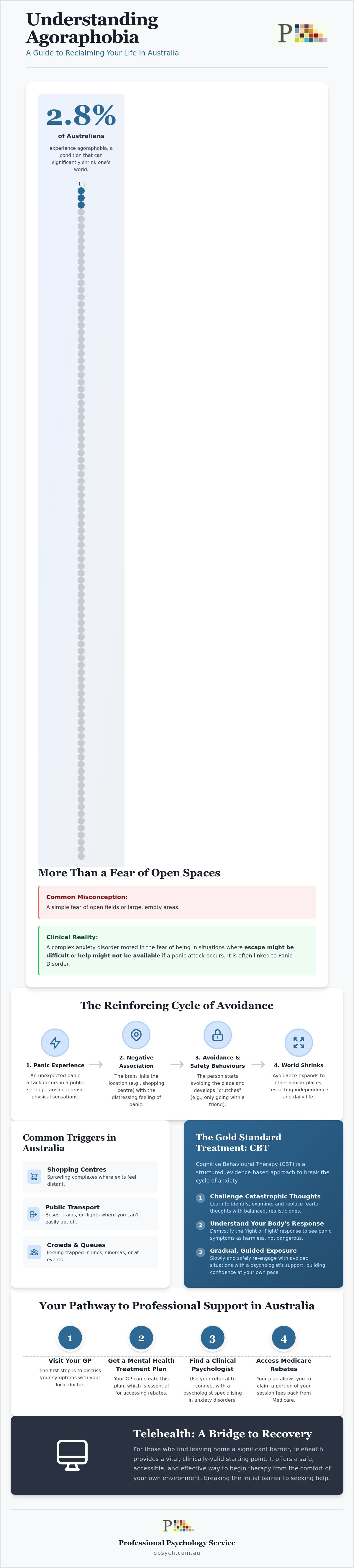
Agoraphobia is often misunderstood as a simple fear of open fields or large crowds. In reality, it's a complex and debilitating anxiety disorder. It's rooted in the fear of being in environments where escape feels difficult or help might not be available during a panic event. For roughly 2.8% of the Australian population, accessing effective agoraphobia treatment australia wide is the first step toward breaking free from this restrictive cycle. This condition isn't just about physical spaces; it's about the perceived lack of safety within them and the intense anxiety regarding the physical sensations of panic itself.
The condition frequently develops as a secondary response to panic disorder. When someone experiences the distressing physical sensations of a panic attack in a public setting, their brain begins to associate that location with danger. This leads to avoidance. Over time, this avoidance shrinks their world, impacting their ability to work, maintain social connections, and perform simple daily tasks like grocery shopping. For a comprehensive overview of agoraphobia, it's helpful to see how these symptoms can escalate from avoiding one specific bus route to being unable to leave the home at all. Seeking a formal clinical diagnosis from a professional is vital. Self-diagnosis often misses the nuanced underlying triggers, whereas a clinical psychologist can map out a precise, research-backed pathway for recovery that addresses your specific fears.
Common Triggers in the Australian Environment
Living in Australia presents specific challenges for those managing this condition. Our daily lives often require us to navigate environments that feel inherently "unsafe" when anxiety is high. Common triggers include:
Shopping centres: Navigating sprawling complexes like a Westfield, where exits feel distant and the environment is unpredictable.
Public transport: Using suburban trains, buses, or even domestic flights where you cannot simply "escape" between designated stops.
Social and civic spaces: Standing in long queues at the post office, sitting in the middle of a cinema row, or being part of a large crowd at a sporting event.
The Role of Safety Behaviours
To cope with the overwhelming fear, many individuals develop "safety behaviours." These are subtle actions or requirements that make a situation feel more bearable. You might find you only feel comfortable leaving the house with a "safe" person, or perhaps you always sit near the exit in a cafe. Some people carry specific items, like a mobile phone or a bottle of water, as a psychological crutch.
While these behaviours provide temporary relief, they unintentionally reinforce the anxiety loop. They prevent you from learning that the situation itself isn't dangerous. Your brain begins to believe you only survived the experience because of the crutch, not because you were actually safe. A core part of agoraphobia treatment australia based involves identifying these patterns. Under clinical guidance, you'll learn to gradually retire these behaviours, proving to yourself that you are capable of navigating the world independently.
Evidence-Based Psychological Treatments for Agoraphobia
Cognitive Behavioural Therapy (CBT) remains the gold-standard clinical approach for managing complex anxiety. When exploring agoraphobia treatment options, it's reassuring to know that CBT is backed by extensive research and provides practical tools for long-term recovery. This therapy isn't about "just thinking positively." Instead, it's a structured method for identifying and challenging the catastrophic thought patterns that keep you trapped. For example, a thought like "If I go to the shops, I will faint and no one will help me" is examined for evidence and replaced with more balanced, realistic perspectives.
A vital component of this process is physiological education. Understanding the "fight or flight" response helps demystify the intense physical sensations of panic. When you know that a racing heart or shortness of breath is simply your body's way of preparing for a perceived threat, those sensations lose much of their power. Your clinical psychologist acts as a steady guide, ensuring that treatment is a collaborative and carefully paced journey. You are never forced into situations you aren't ready for; instead, you work together to build a foundation of safety. This partnership is at the heart of effective agoraphobia treatment australia wide.
Graded Exposure Therapy: A Step-by-Step Approach
Graded exposure is often the most transformative element of recovery. In this phase, you and your psychologist create a "hierarchy of fears," which is a list of situations ranked from least to most distressing. You might start by simply standing on your front porch and gradually work your way up to visiting a local park or a busy shopping centre. Graded exposure is a controlled clinical technique to build resilience. By facing these situations in a systematic way, your nervous system learns that the predicted catastrophe doesn't occur, allowing your anxiety to naturally diminish over time.
Addressing Co-occurring Conditions
Recovery is rarely a linear path, and agoraphobia often doesn't exist in isolation. Clinical psychologists conduct thorough assessments to identify if you are also managing panic disorder, social anxiety, or underlying depression. In some instances, the fear of leaving home is a response to past events. If your experience is rooted in complex history, you may find our guide on Trauma and PTSD Treatment: A Clinical Guide to Recovery and Resilience particularly helpful. Effective agoraphobia treatment australia based must account for these complexities to ensure a stable and lasting recovery. If you're ready to explore these evidence-based pathways, you can connect with our clinical team to discuss a tailored support plan.
Telehealth: Breaking the Barrier to Anxiety Support
Recovering from agoraphobia often presents a frustrating catch-22: the very condition that prevents you from leaving your home is the one that traditionally requires you to travel to a clinic for help. This physical barrier is a primary reason why many individuals delay seeking agoraphobia treatment australia wide. Telehealth has effectively dismantled this obstacle, positioning itself as a clinically valid bridge to recovery. By starting therapy in your own living room, you can establish a strong rapport with your psychologist in a space where you already feel secure, rather than beginning the process in a state of heightened distress.
Modern clinical psychology uses digital platforms to do more than just talk. Telehealth allows for "in-vivo" exposure therapy, where your psychologist can virtually "walk" with you using a mobile device as you take your first steps outside. Whether you're walking to your front gate or driving to the local corner store, your clinician provides real-time support and coaching. This immediate feedback helps you apply anxiety-management techniques exactly when you need them most. When looking for Australian mental health support, it's vital to consider how this delivery method can be tailored to your current capacity for travel.
Is Telehealth as Effective as In-Person Therapy?
Extensive research confirms that Cognitive Behavioural Therapy (CBT) delivered via video link produces outcomes comparable to traditional face-to-face sessions. The clinical techniques remain the same; it's simply the medium that changes. To ensure a professional experience, we use secure, encrypted platforms that meet strict Australian privacy standards. While some worry about the "human connection" in a digital space, many clients find that the reduced stress of not having to commute actually allows for a deeper, more focused therapeutic relationship. It's a stable, reliable way to access high-level care without the initial trauma of a forced outing.
National Accessibility for All Australians
Telehealth has transformed the landscape of agoraphobia treatment australia based, especially for those living in rural or remote regions where specialised clinical psychologists may be hundreds of kilometres away. In 2024–25, 1 in 10 Australians received Medicare-subsidised mental health services, and the rise of digital care has been a significant driver of this increased accessibility. Professional Psychology Service is committed to providing this stable anchor of care to all Australians, regardless of their postcode. This flexibility also means you can organise your sessions around family or work commitments, ensuring that your path to independence is sustainable and fits into your daily life.
Navigating the Australian Healthcare System for Support
The Australian healthcare system is designed to provide a structured pathway to recovery, but the administrative steps can feel daunting when you're already managing significant anxiety. To begin your journey, your first point of contact is almost always a General Practitioner (GP). They serve as the essential link between your current experience and the specialised clinical care required for recovery. When seeking agoraphobia treatment australia wide, having a GP who understands your history is a vital first step in creating a stable support network.
During your appointment, the GP will assess your symptoms and, if appropriate, prepare a Mental Health Treatment Plan (MHTP). This document is crucial because it allows you to claim Medicare rebates for up to 10 individual psychology sessions per calendar year. It's a professional framework that ensures your care is recognised and subsidised by the national health system. When you speak with your doctor, don't be afraid to be specific about your fears of leaving the house or your experiences with panic. This clarity helps them provide the most accurate referral to a psychologist who specialises in anxiety disorders.
It's also helpful to understand the distinction between a general psychologist and a clinical psychologist. Clinical psychologists have completed additional years of specialised training in the assessment and treatment of complex mental health conditions. As of July 1, 2026, the Medicare rebate for a 50-minute session with a clinical psychologist is $149.05, while the rebate for a general psychologist is $101.55. This higher rebate reflects the clinical psychologist's advanced expertise in managing the intricate layers of agoraphobia and panic disorder.
How to Access Medicare Rebates
Accessing financial support for your sessions involves a straightforward three-step process:
Step 1: Book a long consultation with your GP. It's helpful to mention you're seeking a Mental Health Treatment Plan so they can allocate enough time for a thorough assessment.
Step 2: Discuss your concerns openly to obtain your MHTP and a formal referral letter addressed to your chosen psychologist or clinic.
Step 3: Provide these documents to your psychology clinic before or during your first session to ensure your Medicare rebates are processed correctly.
Understanding Clinical Consultation Fees
While Medicare rebates significantly reduce the cost of care, most private practices have a "gap" fee. This is the difference between the psychologist's total fee and the Medicare rebate. Viewing therapy as a long-term investment in your wellbeing is a helpful perspective, as the skills you acquire often lead to a profound return to independence. For a deeper look at how these systems interact, you can read our guide on Trauma Recovery and Medicare: A Guide to Clinical Psychological Support. If you're ready to take the next step in your recovery, you can contact our team at Professional Psychology Service to discuss how we can support your path back to independence.
Reclaiming Your Life with Professional Psychology Service
Reclaiming your independence is a journey that requires both high-level clinical expertise and a deep, genuine sense of safety. At Professional Psychology Service, we specialise in bridging that gap for individuals who feel restricted by anxiety. Led by Dr Claire Cashman, a Doctor of Clinical Psychology, our practice is dedicated to providing high-quality agoraphobia treatment australia wide through evidence-based pathways. We don't just focus on the symptoms of panic; we focus on the person behind them, ensuring that every step toward recovery is taken at a pace that feels manageable, secure, and respectful of your unique experience.
Our commitment to research-backed methods means that your treatment is grounded in established psychological science. We primarily utilise Cognitive Behavioural Therapy (CBT) and trauma-informed care to help you dismantle the cycles of avoidance that have narrowed your world. By combining this clinical authority with a non-judgemental, supportive environment, we help you transform fear into resilience. We believe that freedom is achievable for everyone, provided they have access to a stable practitioner who understands the intricate relationship between the mind, the body, and the environment.
A Compassionate Partner in Your Recovery
Our approach balances professional clinical authority with human warmth. We understand that the world can feel overwhelming when your safety feels compromised, and our role is to act as a stable anchor during your recovery. The therapeutic journey at Professional Psychology Service follows a methodical, calm rhythm. We don't believe in high-pressure tactics or rushing the process. Instead, we prioritise a steady progression that fosters genuine growth. Our goal is to help you acquire the practical life skills needed to navigate your local community, whether that involves visiting a busy shopping centre or simply walking to the end of your street with confidence.
Take the First Step Today
Starting your journey toward recovery doesn't require an immediate, stressful outing. Because we offer national telehealth services, your first clinical assessment can take place exactly where you feel safest. This ease of access ensures that your path to independence begins on your terms, without the initial trauma of a forced commute. We handle every enquiry with the utmost confidentiality and care, ensuring you feel heard from the very first point of contact.
If you're ready to explore how specialised agoraphobia treatment australia based can help you reclaim your freedom, we invite you to reach out for a confidential discussion. You don't have to navigate this complex path alone. Our team is here to provide the quiet strength and professional guidance you need to step back into the world, one certain step at a time. Your world doesn't have to stay small; let us help you find the way back to a full and independent life.
Taking Your First Steps Toward Independence
Living with agoraphobia often makes your world feel incredibly small, but it doesn't have to stay that way. We've explored how understanding your triggers and using evidence-based methods like Cognitive Behavioural Therapy can help you dismantle the cycle of avoidance. By navigating the Australian healthcare system through your GP and a Mental Health Treatment Plan, high-quality care becomes both accessible and subsidised.
Finding effective agoraphobia treatment australia wide is now more achievable thanks to the clinical validity of telehealth, which allows you to start your recovery where you feel safest. Professional Psychology Service, led by Clinical Psychologist Dr Claire Cashman, is registered with the Psychology Board of Australia and committed to a rigorous, evidence-based clinical approach. We provide a stable, compassionate anchor to help you build resilience and reclaim the independence you deserve.
Begin your journey to recovery with Professional Psychology Service – contact us today. You have the capacity for growth, and with the right professional guidance, the world can become a safe and welcoming place once more.
Frequently Asked Questions
Can agoraphobia be cured completely with psychological treatment?
Psychological treatment offers a high probability of significant recovery and long-term symptom management. While "cure" is a definitive term, many individuals achieve a state where they no longer meet the diagnostic criteria for the disorder and can navigate the world without fear. Success depends on the consistent application of evidence-based techniques, such as those found in comprehensive agoraphobia treatment australia based programs.
Do I need a referral to see a clinical psychologist for agoraphobia?
You don't strictly need a referral to see a psychologist as a private patient, but you do need one to access Medicare rebates. To receive the specialised rebate for a clinical psychologist, you must first obtain a Mental Health Treatment Plan and a referral letter from your GP. This process ensures your treatment is part of a coordinated and professionally recognised healthcare approach.
How many sessions of CBT are typically required for agoraphobia?
The number of sessions required varies depending on the complexity and duration of your condition. Many people see significant improvement within 10 to 20 sessions of Cognitive Behavioural Therapy (CBT). Your clinical psychologist will work with you to establish a treatment timeline that reflects your personal goals and the specific pace of your progress.
Will I be forced to leave my house before I am ready during therapy?
No, clinical treatment is a collaborative process where you remain in control of the pace. Your psychologist will never force you into a situation that you aren't ready to handle. We use a graded approach, starting with very small steps that feel manageable and only moving forward once you feel secure and confident in your progress.
Is agoraphobia treatment covered by private health insurance in Australia?
Most Australian private health insurers provide rebates for psychology sessions under their "extras" cover. It's important to check your specific policy for annual limits and per-session amounts. Keep in mind that you cannot claim both a Medicare rebate and a private health insurance rebate for the same session; you must choose one or the other.
What is the difference between agoraphobia and social anxiety disorder?
Agoraphobia is primarily a fear of having a panic attack in a place where escape is difficult, whereas social anxiety is a fear of being judged or embarrassed by others. While they can coexist, the underlying driver is different. Agoraphobia focuses on physical safety and the ability to find a "safe" exit, while social anxiety focuses on social performance.
Can children or teenagers develop agoraphobia?
Agoraphobia can certainly develop in children and teenagers, though it may present differently than in adults. In younger people, it often manifests as school refusal or an intense reluctance to attend social events without a parent or safe person. Early intervention with a clinical psychologist is essential, and families may also find it helpful to engage with services like the Center for Family Healing for parent coaching to better support their child's recovery.
Can I do my exposure therapy sessions via telehealth?
Yes, exposure therapy is highly effective when conducted via telehealth using mobile devices. Your psychologist can virtually accompany you on "in-vivo" exposure tasks, providing real-time coaching while you navigate a local park or shopping centre. This allows you to receive professional support in the exact moments when your anxiety is triggered, which is a key benefit of agoraphobia treatment australia wide.


Comments