




Anger Management Sunshine Coast: Clinical Techniques for Adults
- Claire Cashman
- 6 days ago
- 12 min read
Updated: 5 days ago
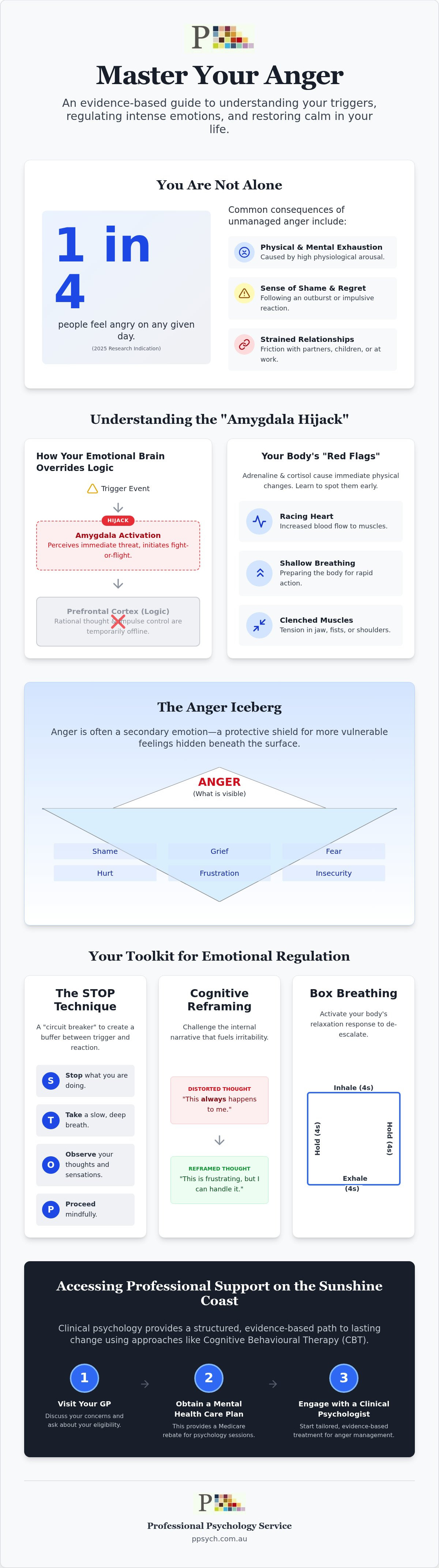
Did you know that as of 2025, research indicates nearly one in four people feel angry on any given day? If you've found yourself physically exhausted by high physiological arousal or carrying a heavy sense of shame after a recent outburst, you're certainly not alone. It's incredibly difficult when strained relationships with your partner or children, or perhaps friction at work, begin to feel like an unmanageable weight. When exploring options for anger management Sunshine Coast adults often seek a clinical approach that moves beyond simple advice to address the underlying mechanics of their reactions.
This article outlines how to master evidence-based strategies to regulate intense emotions and restore balance to your personal and professional life. You'll learn how to develop a vital buffer between your triggers and reactions, allowing you to choose your response rather than simply reacting. We'll also explore the root causes of irritability and provide practical tools to improve communication during conflict, helping you achieve a genuine and lasting sense of internal calm.
Table of Contents
Understanding the Physiology of Anger in Adults
Anger is often misunderstood as a purely mental state or a character flaw. In a clinical setting, we recognise it as a fundamental survival mechanism. It's the "fight" component of the body's ancient fight-or-flight response, triggered whenever we perceive a threat to our physical safety, our values, or our social standing. When exploring Anger management, the first step is acknowledging that your body is essentially trying to protect you, even if its methods have become disruptive to your daily life.
The most intense outbursts are often the result of an "Amygdala Hijack". The amygdala is a small, almond-shaped part of the brain responsible for processing immediate emotional threats. When it senses a crisis, it can effectively override the prefrontal cortex, which is the area responsible for logic, reasoning, and impulse control. This neurological override explains why people often feel they "lose control" or say things they later regret. During these moments, your rational brain is literally offline.
As this process unfolds, your body releases a surge of adrenaline and cortisol. These hormones cause immediate physical changes, often referred to as "red flags". You might notice a racing heart, shallow breathing, or a sudden clenching of the jaw. For those seeking anger management Sunshine Coast, learning to identify these physiological markers early is vital. It allows you to intervene before the emotional brain takes full command. There's a significant difference between healthy assertiveness, which involves standing up for your needs with respect, and maladaptive aggression, which is a defensive reaction intended to dominate or push others away.
The Brain-Body Connection
When your sympathetic nervous system prepares for a "fight", it diverts blood flow away from your digestive system and toward your large muscle groups. This physiological shift is why you might feel "on edge" or physically restless when frustrated. Your prefrontal cortex should ideally act as a regulator, helping you decide if the situation truly warrants such a high-level response. However, if you're under chronic stress, this regulatory system can become fatigued. Physical symptoms often appear well before you have a conscious thought of being angry, making body awareness a primary tool for regulation.
Because the body and mind are so closely linked, addressing the physical manifestations of stress is a key part of recovery. For instance, residents in Western Australia often find that consulting a chiropractor Golden Bay helps to alleviate the musculoskeletal tension and "on edge" feeling that comes from a hyperactive nervous system.
Anger as a Secondary Emotion
Psychologists frequently use the "Anger Iceberg" metaphor to illustrate that what we see on the surface is rarely the whole story. While anger is the visible emotion, it often sits atop a foundation of more vulnerable feelings like shame, grief, or fear. Many adults default to anger because it feels more powerful and less exposed than admitting to being hurt. We define emotional masking as a clinical defence mechanism where an individual uses a "harder" emotion like anger to shield themselves from deeper, more painful vulnerabilities. Identifying these underlying drivers is a core focus of the evidence-based care provided at Professional Psychology Service.
Practical Anger Management Techniques for Adults
Once you understand the physiological alarm system discussed in the previous section, the next step is developing a toolkit of "circuit breakers". These are immediate interventions designed to interrupt the physical surge of adrenaline before it leads to an outburst. Effective anger management strategies often begin with the STOP technique. This structured approach involves four distinct steps: Stop what you are doing; Take a slow, deep breath; Observe your thoughts and physical sensations without judgment; and Proceed mindfully. This simple sequence creates the necessary "buffer" between a trigger and your reaction.
Beyond physical interventions, we must address the internal narrative. Cognitive reframing involves identifying "black-and-white" thinking or rigid "should" statements, such as "They should have known better" or "This always happens to me". These thoughts act as fuel for irritability. By challenging these distortions, you can shift from a defensive posture to a more flexible, problem-solving mindset. In our clinical psychology sessions, we work with clients to replace these demands with more realistic preferences, which significantly lowers emotional intensity. This process is a core component of effective anger management sunshine coast.
De-escalation Strategies
If you feel your heart rate climbing, box breathing is an excellent tool. By inhaling, holding, and exhaling for equal counts of four, you stimulate the vagus nerve. This sends a direct signal to your brain to deactivate the fight-or-flight response. For moments when you feel detached or overwhelmed, grounding exercises like the 5-4-3-2-1 method help pull your focus back to the present by identifying objects you can see, hear, or touch. In the digital age, applying a "24-hour rule" before responding to provocative emails or messages prevents impulsive communication that often leads to workplace conflict or disciplinary risks. Managing these psychosocial hazards is a vital part of modern occupational health, with organisations like Persona Health helping businesses navigate workplace injury management and medical assessments to ensure a safer environment for all.
Long-term Regulation Habits
Sustainable change requires more than just reactive tools. Building emotional resilience involves maintaining consistent sleep hygiene and a balanced diet, as physical depletion often lowers our threshold for frustration. We recommend developing an "Early Warning System" by tracking your daily irritability on a scale of one to ten. Journaling serves as a powerful tool for identifying recurring environmental triggers that consistently lead to stress. This proactive approach is a cornerstone of anger management sunshine coast, ensuring you aren't just managing crises but building a foundation of lasting internal calm, which can be furthered by engaging with story-driven resources like Dr. Grant Johnson - Common Sense Psychology for Everyday Living.
The Role of Cognitive Behavioural Therapy (CBT) in Emotional Regulation
Cognitive Behavioural Therapy (CBT) is widely regarded as the gold standard for treating emotional dysregulation. Unlike the common misconception that therapy is merely "talking about feelings", CBT is a structured, goal-oriented approach. It focuses on the intricate relationship between your thoughts, feelings, and behaviours. For those seeking anger management sunshine coast, this clinical framework provides a practical roadmap to move from reactive outbursts to intentional regulation. It's about gaining mastery over your internal environment rather than simply trying to suppress a natural emotion.
Clinical psychologists help individuals identify "automatic negative thoughts" (ANTs). These are the split-second interpretations that occur immediately after a trigger. If a colleague misses a deadline, an ANT might be, "They don't respect my time." This thought then fuels the physiological surge of anger. By using specific cognitive-behavioral techniques, you can learn to pause and evaluate these thoughts before they dictate your actions. Another vital component is Behavioural Activation. This involves identifying healthier outlets for the intense physical energy that anger generates, ensuring that the "surge" is channelled constructively rather than destructively into your relationships or career.
Identifying Cognitive Distortions
Cognitive distortions are biased ways of thinking that maintain emotional distress. Two of the most common distortions in anger are personalisation and catastrophising. Personalisation occurs when you believe others are "doing it on purpose" or that their actions are a direct slight against you. Catastrophising involves turning a minor inconvenience, like a traffic delay, into a major disaster. CBT restructures the neural pathways associated with reactivity by repeatedly practising more balanced and realistic interpretations of events.
Integrating Trauma-Informed Care
It's also essential to consider how past experiences shape current reactions. Often, what looks like a "short fuse" is actually a symptom of hypervigilance. This state of constant alertness is frequently seen in those requiring trauma and PTSD treatment. When the brain is stuck in a survival loop, even minor stressors can feel like significant threats. A thorough clinical assessment is vital to rule out underlying PTSD, as the approach for trauma-related irritability differs from general anger management. This depth of care is a hallmark of professional anger management sunshine coast services, ensuring the root cause of the irritability is addressed with compassion and clinical precision.
Accessing Anger Management Support on the Sunshine Coast
Deciding to seek professional help is a significant step toward reclaiming control over your life. While there are various options for anger management sunshine coast, navigating the healthcare system can sometimes feel overwhelming when you're already under stress. For individuals with complex needs, engaging with registered NDIS providers such as Accessible Care can provide additional avenues for specialised support. The most common and effective pathway for many, however, is through the Medicare system, which ensures that high-quality clinical care remains accessible to the community. By following a structured process, you can ensure you're receiving evidence-based treatment from qualified professionals.
Navigating Medicare and Rebates
To begin, you'll need to book a long appointment with your GP for a mental health assessment. During this consultation, your doctor will discuss your symptoms and, if appropriate, create a Mental Health Care Plan (MHCP). This document is essential because Medicare support for psychological care allows you to claim rebates for up to 10 individual sessions per calendar year. These rebates significantly reduce your out-of-pocket expenses for clinical treatment. It's helpful to remember that you'll need a specific referral letter from your GP addressed to your chosen psychologist to activate these benefits.
Finding the Right Clinical Fit
It's important to understand the difference between general counselling and clinical psychology. While the term 'counsellor' isn't a protected title in Australia, a clinical psychologist is a highly regulated health professional registered with the Psychology Board of Australia. Practitioners at Professional Psychology Service hold doctorate-level qualifications, which provides a deeper capacity for complex assessment. This level of expertise is a vital consideration when choosing a provider for anger management sunshine coast. When you make an initial enquiry, don't hesitate to ask about the therapist's experience with adult emotional regulation. A safe, non-judgemental environment is the foundation of effective therapy, allowing you to explore the root causes of your irritability without fear of criticism.
Preparing for your first clinical consultation doesn't have to be a daunting task. It's often helpful to write down a few recent examples of when you felt your reactions were out of proportion to the situation. This provides a concrete starting point for your clinician to understand your unique triggers and physiological "red flags". If you're ready to move toward a more balanced life, you can book a consultation with our clinical team to discuss a tailored treatment plan that meets your specific needs.
Evidence-Based Care at Professional Psychology Service
At Professional Psychology Service, we provide a stable anchor for adults navigating the complexities of emotional regulation. Our clinical team is committed to delivering high-level medical alternatives to general life coaching, ensuring that every client receives care rooted in rigorous scientific research. When seeking anger management sunshine coast, it's vital to choose a practitioner who understands that long-term change requires more than just willpower; it requires the acquisition of practical, research-backed life skills. We focus on helping you move from a state of constant reactivity to one of calm, intentional response.
Our approach to adult emotional health begins with a thorough clinical assessment. We move beyond surface-level symptoms to understand the specific physiological and cognitive patterns that drive your irritability. Following this assessment, we implement tailored Cognitive Behavioural Therapy (CBT) to help you build emotional literacy and resilience. By working within our professional, private clinic setting in Coolum Beach, you can explore these challenges in a discreet and supportive environment designed to lower anxiety and foster growth. Just as a clinical space is curated for comfort, your home environment can also be a source of peace; you can learn more about Raw at Home to discover how professional styling creates serene living spaces. This structured environment ensures you feel both respected and cared for as you develop the tools necessary for lasting change.
Why Choose a Clinical Specialist?
Choosing a clinical specialist ensures that your treatment plan is guided by deep knowledge and high ethical standards. Our practice is led by Dr Claire Cashman, who holds a Doctorate in Clinical Psychology and is fully registered with the Psychology Board of Australia. This level of expertise allows for a more sophisticated integration of research-backed methods into your care. We maintain a steady focus on your individual journey, ensuring that every session adheres to the latest professional competencies. By prioritising evidence-based practice, we help you transition from reactive patterns to a life of quiet strength and internal stability.
Getting Started with Your Recovery
Taking the first step toward change is often the most challenging part of the process. To begin, you can make a confidential booking enquiry via our website or by calling our Coolum Beach centre directly. Your initial 50-minute clinical consultation is a dedicated time for us to listen to your experiences and begin mapping out a pathway for your recovery. We'll discuss your goals and how our specialist experience in trauma and relationship counselling can support your specific needs. It's important to remember that intense anger is a manageable condition. With the right clinical guidance and a commitment to evidence-based strategies, you can restore balance to your relationships and achieve a genuine sense of internal peace.
Reclaiming Calm and Control in Your Life
Mastering your emotional responses is a journey that begins with understanding the biological mechanics of irritability and ends with the application of clinical frameworks like Cognitive Behavioural Therapy. By identifying your unique physical red flags and restructuring automatic negative thoughts, you can move away from the cycle of reactive outbursts and toward a life of intentional response. For those seeking professional anger management sunshine coast, the combination of evidence-based techniques and expert clinical guidance provides a reliable pathway to lasting change.
At Professional Psychology Service, our clinical psychologists offer doctorate-level training and utilise proven CBT and DBT frameworks to support your growth. We provide a private and confidential clinical environment where you can safely address the root causes of emotional dysregulation. Take the first step toward emotional balance; Enquire with Professional Psychology Service today. You don't have to navigate these challenges alone. With the right tools and a compassionate professional hand to guide you, restoring balance to your relationships and professional life is entirely within reach.
Frequently Asked Questions
How do I know if my anger is "normal" or if I need professional help?
Anger requires professional help when it becomes frequent, intense, or leads to negative consequences in your relationships and career. If you experience the "amygdala hijacks" mentioned earlier or feel a heavy sense of shame after an outburst, clinical support is beneficial. Other signs include physical exhaustion from high physiological arousal or a persistent feeling that your reactions are out of proportion to the situation.
Can I get a Medicare rebate for anger management on the Sunshine Coast?
Yes, you can receive a Medicare rebate for psychological services if you obtain a Mental Health Care Plan from your GP. While generic anger management counselling often isn't covered by Medicare, clinical psychology sessions focused on emotional regulation are eligible. This process makes professional anger management sunshine coast more accessible by significantly reducing out-of-pocket costs for up to 10 sessions per calendar year.
What is the difference between an anger management course and clinical psychology?
Clinical psychology provides a deeper, individualised assessment compared to the general skills typically taught in a standard anger management course. While courses offer broad techniques, a clinical psychologist with doctorate-level training identifies the specific root causes of your irritability. This might include underlying trauma or specific cognitive distortions, allowing for a tailored CBT approach that addresses your unique triggers and history.
How many sessions will I need to see a real difference in my reactions?
Most clients begin to notice a meaningful shift in their reactions within six to ten sessions of focused clinical work. The exact number of consultations depends on the complexity of your triggers and your consistency in practising the "circuit breaker" skills between appointments. Initial sessions focus on immediate de-escalation, while later sessions build the long-term emotional literacy required for permanent change and internal calm.
Will anger management therapy make me lose my drive or assertiveness?
No, effective therapy actually enhances your assertiveness by helping you communicate your needs without the destructive interference of aggression. We aim to preserve your "drive" while removing the physiological "noise" that leads to impulsive outbursts. You'll learn to stand your ground calmly and effectively. This often leads to better professional outcomes than reacting with a "short fuse" that can risk disciplinary action.
Does Professional Psychology Service offer online or telehealth sessions for anger?
Professional Psychology Service provides telehealth consultations for individuals who are unable to attend our Coolum Beach clinic in person. These sessions are conducted via secure, encrypted video platforms and maintain the same level of clinical rigour and confidentiality as face-to-face appointments. Telehealth is a convenient and effective option for those seeking specialised anger management sunshine coast support from the comfort of their own home.
Can these techniques help with my relationship or marriage difficulties?
Yes, improving your emotional regulation is one of the most effective ways to restore balance and safety to a strained relationship or marriage. When you develop a "buffer" between your triggers and your reactions, you create the necessary space for healthier communication and conflict resolution. We also provide relationship counselling specifically designed to help couples navigate high-conflict dynamics and rebuild trust after periods of emotional volatility.
What should I do if my partner refuses to seek help for their anger?
If your partner refuses to seek help, focusing on your own boundaries and emotional regulation is the most constructive step you can take. You cannot force another person to change, but you can control your own responses and set clear limits regarding what is acceptable behaviour in your home. Seeking individual support helps you manage the stress of the situation and decide on the healthiest path forward.


Comments