




Clinical Psychologist Sunshine Coast: A Guide to Specialist Psychological Care
- Claire Cashman
- Jul 10
- 10 min read
Updated: Jul 13
Navigating the path to mental wellness can feel overwhelming, especially when faced with complex challenges like trauma, PTSD, or the need for formal psychological assessments. On the Sunshine Coast, finding the right support means understanding the different levels of psychological care available. This guide is designed to clarify the distinct advantages of seeing a clinical psychologist, helping you make an informed decision for yourself or your family.
Discover the difference that doctoral-level clinical expertise makes in treating complex mental health conditions and navigating the Australian healthcare system. It’s about moving beyond general counselling to access a deeper, more specialised form of care rooted in scientific evidence and advanced training.
Table of Contents
The Distinction of Clinical Psychology in Australia
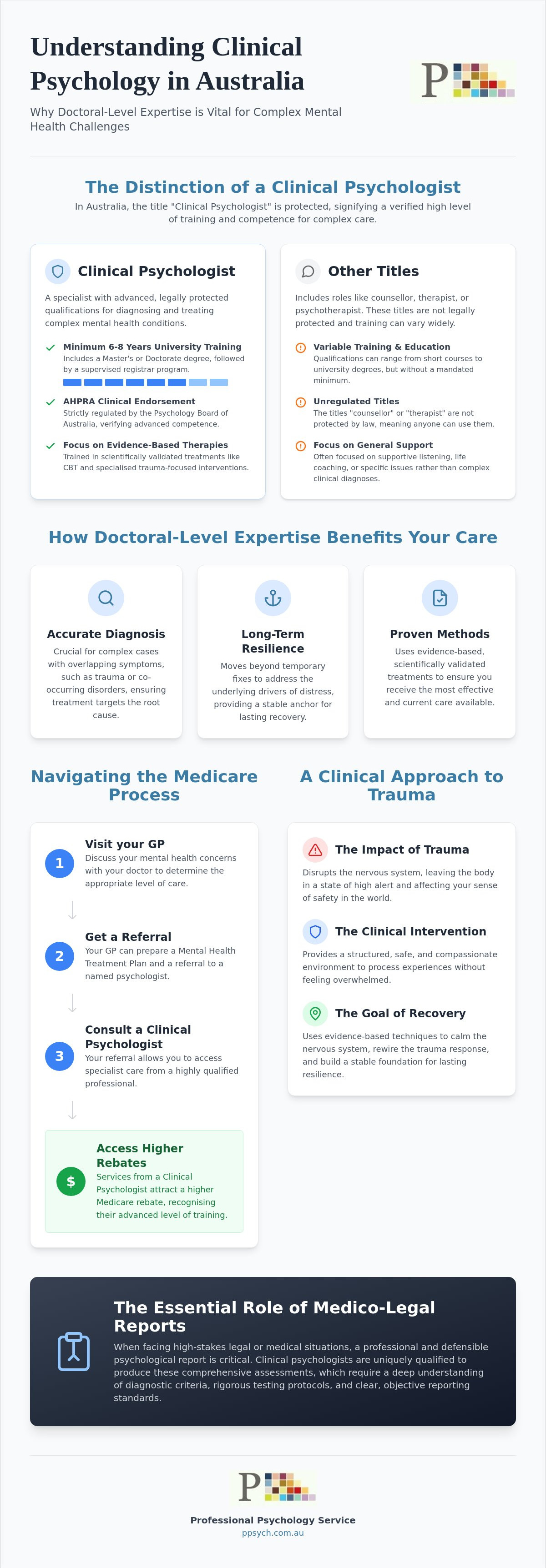
In Australia, the term "psychologist" is a protected title, but not all psychologists have the same level of advanced training. A Clinical Psychologist represents a specific class of practitioner who has completed post-graduate university training at a Master's or Doctoral level, focusing on the assessment, diagnosis, and treatment of complex mental health disorders. This advanced qualification is formally recognised by the Psychology Board of Australia (which operates under AHPRA, the Australian Health Practitioner Regulation Agency) through a specific "area of practice endorsement."
This endorsement is not just a title; it is a national standard of excellence. It signifies that the practitioner has undergone extensive, supervised training to manage a wide spectrum of psychological issues, from severe anxiety and depression to personality disorders and trauma. This contrasts with general counselling or psychotherapy, which may not always be bound by the same rigorous, evidence-based methodologies required in clinical practice. The clinical approach is holistic, considering the biological, psychological, and social factors that contribute to your wellbeing.
Why Advanced Training Matters for Your Care
The rigorous training a clinical psychologist undertakes is directly beneficial to their patients. This process involves years of supervised practice and a deep engagement with scientific research, which translates into more accurate and nuanced diagnostic assessments. Rather than simply addressing surface-level symptoms, a clinician with this background can identify the underlying patterns and root causes of distress.
This depth of knowledge ensures that your treatment plan is not a one-size-fits-all solution. It is a carefully constructed strategy tailored to your unique history, biology, and circumstances. The ultimate goal of clinical care extends beyond short-term coping mechanisms; it is about building long-term resilience, fostering profound self-understanding, and empowering you with the skills to lead a more fulfilling life.
The Evidence-Based Approach to Mental Health
The gold standard for psychological practice in Australia is an "evidence-based" approach. This means that the therapeutic techniques used have been scientifically tested and proven effective through high-quality, peer-reviewed research. Clinical psychologists are experts in delivering these treatments, such as Cognitive Behavioural Therapy (CBT), Schema Therapy, and Eye Movement Desensitisation and Reprocessing (EMDR).
Choosing a practitioner committed to evidence-based care ensures you are not engaging in therapy based on fads or unproven theories. Clinical psychologists have a professional obligation to stay current with the latest research, continually refining their skills to provide the most effective care possible. This commitment to scientific rigour provides a solid, reliable foundation for your recovery journey.
Specialist Treatment for Trauma, PTSD, and Complex Needs
For individuals living with the effects of trauma or Post-Traumatic Stress Disorder (PTSD), specialist care is not just beneficial—it is essential. A clinical psychologist on the Sunshine Coast with expertise in this area provides a structured, safe, and methodical approach to healing. Therapy is carefully organised to establish a stable and trusting environment, which is the cornerstone of effective trauma recovery.
This process, known as trauma-informed care, recognises the widespread impact of trauma and understands potential paths for recovery. It is applied to both children and adults, adapting to the unique developmental and emotional needs of each person. Furthermore, a clinician is skilled in managing co-occurring conditions, such as the depression, anxiety, or substance use issues that often accompany a history of trauma, ensuring all aspects of your mental health are addressed cohesively. For those accessing support through the NDIS, high-quality care providers like Im with you can offer the additional practical assistance needed to navigate these challenges effectively.
Healing from Trauma: A Clinical Perspective
Trauma leaves a tangible imprint on the brain and nervous system, altering threat-detection circuits and keeping the body in a state of high alert. A clinical intervention does more than just talk about the traumatic event; it works to help the nervous system regulate itself and "re-wire" these ingrained trauma responses. Techniques like EMDR, for example, are specifically designed to help the brain process and integrate traumatic memories so they no longer trigger overwhelming distress.
Throughout this delicate work, the therapeutic relationship remains paramount. A specialist provides a compassionate, non-judgmental space where you can explore difficult experiences without fear of criticism. This relationship is the stable anchor that makes deep, lasting healing possible.
Addressing Eating Disorders and Relationship Issues
Beyond trauma, clinical psychology offers specialised frameworks for other complex life challenges. The treatment of eating disorders, for instance, requires a highly specialised skill set to address the intricate interplay of psychological, biological, and social factors. A clinical psychologist can coordinate with other health professionals, like dietitians and GPs, to provide comprehensive, wrap-around care.
Similarly, relationship and interpersonal issues can often stem from deep-seated patterns learned early in life. A psychologist with advanced training can help you understand these dynamics, whether in individual or couples counselling, and develop healthier ways of relating to others. The overarching goal is always to restore your sense of agency, wellbeing, and connection.
Clinical expertise is also essential for managing neurodevelopmental conditions that persist into adulthood. For those requiring a structured approach to ADHD, collinspsychology.com provides evidence-based therapy programs tailored to these specific cognitive and emotional needs.
The Essential Role of Medico-Legal Reports
A medico-legal report is a formal psychological assessment prepared for legal, insurance, or institutional purposes. These high-stakes documents require an exceptional level of clinical rigour, objectivity, and expertise, which is why a clinical psychologist is the preferred expert for their preparation. Many psychology practices do not offer this service due to its complexity, creating a significant gap for those in need.
These reports are often required in cases involving personal injury claims, workers' compensation, family law disputes, or fitness-for-duty evaluations. The psychologist’s role is to provide an impartial, evidence-based assessment of an individual's psychological state, the impact of an event on their mental health, and their prognosis for recovery. The final report must be meticulously detailed and able to withstand intense scrutiny in a legal setting.
What to Expect During a Medico-Legal Assessment
It is important to understand that a medico-legal assessment is different from a therapy session. Its purpose is evaluation, not treatment. The process typically involves a series of structured clinical interviews, where the psychologist gathers detailed information about your personal, medical, and psychological history. It may also include psychometric testing—the use of standardised, scientifically validated tests to measure cognitive function, personality traits, or the severity of symptoms.
Throughout the assessment, the clinician adheres to strict professional and ethical standards to ensure the process is fair, respectful, and transparent. You will be informed of the purpose of the evaluation, who will receive the report, and the limits of confidentiality.
Expert Witness and Professional Documentation
In some cases, the clinical psychologist may be called upon to act as an expert witness, providing testimony in court to help legal professionals understand the complex psychological factors of a case. Their ability to explain complex concepts in a clear, accessible manner is crucial for judges, juries, or tribunals.
The formal report itself serves as a critical piece of evidence, translating psychological injury into a documented, understandable format. This requires a clinician who is not only an expert in mental health but is also experienced in the unique intersection of psychology and Australian law. This specialised expertise ensures the report is professional, defensible, and serves its intended purpose effectively.
Navigating Medicare and the Referral Process
Accessing high-quality psychological care in Australia is made more affordable through Medicare. The primary pathway is the Mental Health Care Plan (MHCP), a referral provided by your General Practitioner (GP). This plan allows you to claim a Medicare rebate for a set number of sessions per calendar year, significantly reducing your out-of-pocket costs.
Crucially, Medicare provides a higher rebate for sessions with an endorsed clinical psychologist compared to a general psychologist. This two-tier rebate system acknowledges the advanced level of training and expertise required for the clinical endorsement. Many people also find that telehealth services are available, providing a convenient option for those on the Sunshine Coast who may have difficulty attending a clinic in person.
How to Organise Your Mental Health Care Plan
Accessing a rebate is a straightforward process. Follow these simple steps to transition smoothly from your GP visit to your first psychology session:
Step 1: Book a long consultation with your GP. A standard appointment may not be long enough to discuss your mental health concerns thoroughly. Be sure to request a double or long appointment when you book.
Step 2: Discuss your needs and request a referral. Talk openly with your GP about what you are experiencing. If psychological support is appropriate, they can prepare a Mental Health Care Plan and a referral letter addressed to a specific clinical psychologist or practice.
Step 3: Contact the psychology clinic to book your initial consultation. Once you have your referral, you can contact the clinic to schedule your first appointment. You will need to provide the referral details to be eligible for the Medicare rebate.
Understanding Fees and Rebates in 2026
When you pay for your session, you will be charged the psychologist's full fee. You can then use your receipt to claim the Medicare rebate, and the difference between the full fee and the rebate is your "gap" or out-of-pocket expense. [Note: Please verify the specific Medicare rebate amounts for 2026 as they are subject to change.]
While there is an upfront cost, investing in specialist psychological care is an investment in your long-term health. Effective treatment can reduce future medical costs and improve your overall quality of life. It's important to be aware that services like medico-legal reporting and professional supervision are highly specialised and are not covered by Medicare.
Professional Psychology Service: A Stable Anchor for Recovery
At Professional Psychology Service on the Sunshine Coast, our practice is founded on the principles of clinical excellence, scientific rigour, and deep empathy. Led by Dr Claire Cashman, who holds a doctorate in clinical psychology, our team is committed to providing the highest standard of evidence-based treatment for children, adults, and families.
We have intentionally cultivated a calm, supportive, and professional environment where you can feel safe to engage in the important work of therapy. We understand that seeking help takes courage, and we honour that by providing a stable, reliable, and non-judgmental space for your recovery. Our practice is uniquely positioned to handle complex clinical cases, including trauma and professional supervision, that other services may not be equipped for.
Our Compassionate, Clinical Approach
We believe the most effective care balances clinical authority with genuine human warmth. Our team’s approach is defined by quiet strength and methodical progress, ensuring you feel both safe and empowered. We see you as an individual with a unique story, not just a diagnosis. Our commitment is to walk alongside you, providing expert guidance and unwavering support as you navigate your path to wellbeing.
This balance ensures that while our methods are grounded in science, our delivery is grounded in humanity. We invite you to experience a service where your challenges are met with sophisticated clinical skill and your vulnerability is met with profound respect.
A National Standard of Excellence
While our clinic is located locally on the Sunshine Coast, the standard of care we provide is of a national calibre. We are dedicated to upholding the highest professional standards as set by the Psychology Board of Australia. Through telehealth, we extend this level of care to clients across the country. Furthermore, we are committed to advancing the field by providing professional supervision to the next generation of Australian psychologists.
If you are ready to take the next step towards lasting change, we are here to help. Enquire about a clinical consultation or medico-legal report today.
Frequently Asked Questions (FAQs)
What is the difference between a clinical psychologist and a psychiatrist?A clinical psychologist has advanced training in the diagnosis and treatment of mental health disorders using talk therapies. A psychiatrist is a medical doctor who specialises in mental health and can prescribe medication. They often work together to provide comprehensive care.
Do I need a GP referral to see a clinical psychologist on the Sunshine Coast?You do not need a referral to see a psychologist, and you can pay for sessions privately. However, to be eligible to claim a Medicare rebate under a Mental Health Care Plan, a referral from your GP is required.
How many sessions am I entitled to under a Mental Health Care Plan in 2026?Under a Mental Health Care Plan, patients are typically eligible for an initial block of sessions, with a review by their GP to determine if more are needed, up to a maximum number per calendar year. [Note: The exact number of sessions subsidised by Medicare should be verified for 2026.]
Can a clinical psychologist provide a report for my legal case?Yes. Clinical psychologists with experience in this area are highly qualified to conduct medico-legal assessments and provide expert reports for legal matters, such as personal injury or family court cases.
What should I bring to my first clinical psychology appointment?Please bring your GP referral letter and Mental Health Care Plan (if you have one), your Medicare card, and any relevant previous reports or documentation you feel would be helpful for the psychologist to review.
Does Medicare cover the full cost of a clinical psychology session?Medicare provides a substantial rebate, but it does not usually cover the full fee. The remaining amount, known as the "gap fee," is your out-of-pocket expense. Some private health funds may cover a portion of this gap, depending on your policy.
How do clinical psychologists treat PTSD differently than counsellors?A clinical psychologist uses specific, evidence-based therapies like Trauma-Focused CBT or EMDR, which are scientifically proven to be effective for PTSD. Their advanced diagnostic training also allows them to accurately assess for co-occurring conditions and create a more comprehensive treatment plan.
Is telehealth as effective as in-person clinical psychology?Extensive research has shown that for many conditions, telehealth (video conference) sessions are just as effective as in-person therapy. It provides a convenient and accessible way to receive high-quality specialist care from anywhere on the Sunshine Coast or across Australia.


Comments