




Trauma and PTSD Treatment: A Clinical Guide to Recovery and Resilience
- Claire Cashman
- Jul 14
- 11 min read
Recovery from trauma is not an act of willpower, but a biological process of reorganising how your brain and body respond to the past. If you are living with the constant weight of hypervigilance, you likely feel exhausted by the simple effort of trying to feel safe. You might worry that discussing what happened will only make the pain worse, or feel that you are somehow broken beyond repair. These feelings are valid, but they don't have to be your permanent reality. Seeking professional trauma and ptsd treatment is a logical, structured step toward reclaiming your life.
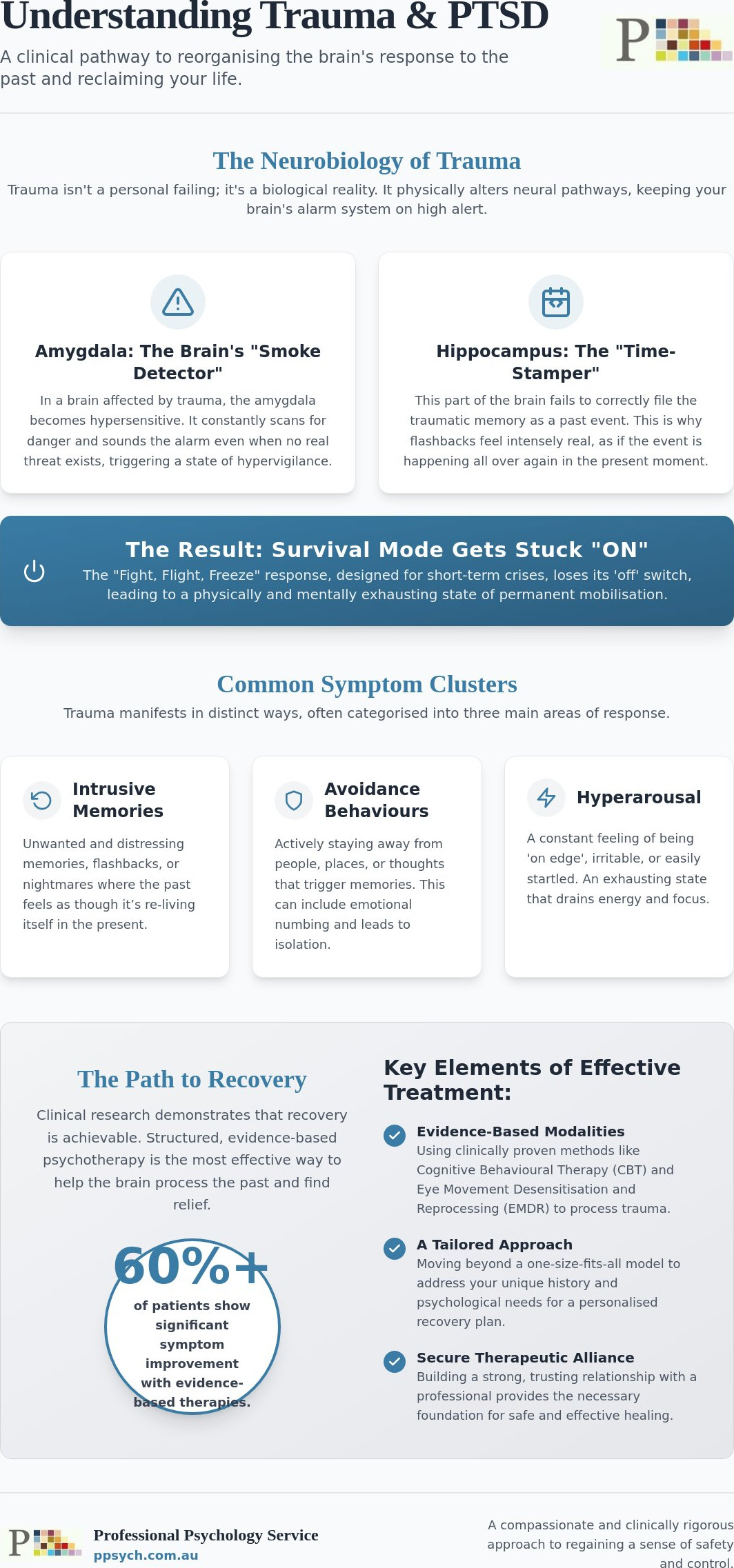
Clinical research indicates that evidence-based psychotherapies lead to significant symptom improvement in more than 60% of patients. This guide provides a clear, authoritative pathway through the clinical options available to you. We'll demystify common therapy acronyms like CBT and EMDR, explain how these methods work to reduce intrusive thoughts, and show you how a research-backed approach can help you regain a sense of safety and calm. You deserve a recovery process that is as compassionate as it is clinically rigorous.
Table of Contents
Understanding Trauma and PTSD: When the Past Stays Present
Trauma is more than a distressing memory; it's an emotional and physiological response to an extraordinary event that overwhelms your capacity to cope. Whether it's a single, life-altering incident or a series of smaller, cumulative stressors, trauma changes how your brain processes the world. It’s helpful to distinguish between 'Big T' traumas, such as natural disasters or physical assaults, and 'little t' traumas, which might include the end of a relationship or workplace bullying. Both are significant. Both deserve care.
When you experience Post-Traumatic Stress Disorder (PTSD), your natural survival mechanism has essentially become 'stuck'. During a crisis, your body enters a state of high alert to keep you safe. In a healthy recovery, this state subsides. However, for some, the alarm system remains active long after the danger has passed. It's vital to understand that this is a physiological reality, not a personal failing or a sign of weakness. Your brain is simply trying to protect you using a map that no longer matches your current environment. Accessing professional trauma and ptsd treatment is the most effective way to update that map and find relief.
Common Symptoms and Warning Signs
The symptoms of trauma are often categorised into three main areas. First, there are intrusive memories or flashbacks, where the past feels as though it’s re-living itself in the present. Second, many people develop avoidance behaviours. This might look like emotional numbing or staying away from people and places that trigger memories. It’s a protective shield, but it often leads to isolation. Finally, there is hyperarousal. This is the constant feeling of being 'on edge', irritable, or easily startled. It’s an exhausting state of being that drains your energy and focus.
The Spectrum of Trauma Exposure
Not all trauma looks the same. A single-incident event may lead to standard PTSD, while prolonged, repeated exposure-often in childhood or within relationships-can result in Complex PTSD (C-PTSD). Children process trauma differently than adults, often expressing distress through changes in play, sleep, or behaviour. Regardless of the source, if your symptoms interfere with your ability to work, maintain relationships, or feel safe, it's time to seek clinical intervention. Understanding the evidence-based treatment modalities for PTSD is a crucial first step in moving from survival to resilience. Professional trauma and ptsd treatment provides the structure needed to reorganise these experiences and regain control.
The Neurobiology of Trauma: Why Your Brain Stays on High Alert
Understanding the biology of trauma helps remove the shame often associated with its symptoms. Inside the brain, the amygdala acts as a sophisticated smoke detector, constantly scanning your environment for danger. In a brain affected by Post-Traumatic Stress Disorder (PTSD), this detector becomes hypersensitive, sounding the alarm even when no fire exists. Simultaneously, the hippocampus, the part of the brain responsible for "time-stamping" memories, often fails to function correctly during an extraordinary event. This failure is why traumatic memories don't feel like past events; they feel as though they are happening right now. Trauma physically alters neural pathways in the brain by strengthening the connections associated with fear and threat detection while weakening those responsible for emotional regulation and logical reasoning.
The "Fight, Flight, Freeze" response is a brilliant survival tool designed for short-term crises. However, when trauma is left unaddressed, this response essentially loses its "off" switch. You find yourself living in a state of permanent mobilisation, which is both physically and mentally punishing. It’s an exhausting way to live, but it is a biological state that can be shifted through targeted clinical work.
The Body Keeps the Score
Trauma doesn't just live in your thoughts; it resides in your muscles, your gut, and your breath. Many people seeking trauma and ptsd treatment report chronic muscle tension, digestive issues, and profound sleep disturbances. These aren't separate medical issues; they are the physical manifestations of a nervous system that cannot find its way back to a resting state. Because these responses are deeply wired into your biology, "just getting over it" is physically impossible without professional help. Your body is doing exactly what it was programmed to do to survive; it simply needs a clinical guide to help it recognise that the crisis has ended.
Breaking the Cycle of Hypervigilance
Clinical psychology focuses on "re-tuning" this overactive nervous system. Before we can process the details of a memory, we must first establish a genuine sense of internal safety. This involves learning practical skills to calm the body’s alarm system, moving you out of a survival-based existence and into a state where growth is possible. Once the body feels secure, the brain can begin the work of reorganising the past. If you feel ready to start this process, our trauma and ptsd treatment services provide a stable, evidence-based anchor for your recovery.
Evidence-Based Trauma and PTSD Treatment Modalities
Choosing the right path for trauma and ptsd treatment is a collaborative process rooted in clinical science. We prioritise evidence-based practice because it offers a predictable, research-backed framework for healing. This isn't about trial and error. It’s about using clinical pathways that have been proven to reduce symptoms and improve quality of life. Your clinical psychologist acts as a professional guide, helping you navigate these options to find the approach that aligns with your specific needs. This tailored strategy ensures that your treatment is as unique as your own story, delivered within a safe and ethical environment.
Cognitive Behavioural Therapy (CBT) and Trauma
CBT operates on the principle that our thoughts, feelings, and behaviours are deeply interconnected. When trauma occurs, it often leaves behind "stuck points"; these are distorted beliefs such as "I am unsafe everywhere" or "It was my fault." Cognitive Processing Therapy (CPT) specifically targets these beliefs, helping you challenge and reorganise them. Another vital component is Prolonged Exposure. This method allows you to safely approach trauma-related memories and cues that you’ve been avoiding. Over time, this reduces the power these memories hold over your daily life, helping you regain a sense of control.
EMDR: Eye Movement Desensitisation and Reprocessing
EMDR is a unique clinical intervention that helps the brain process and integrate traumatic memories. It uses bilateral stimulation, such as guided eye movements, to mimic the way the brain processes information during sleep. This helps "re-file" memories that have been stuck in a raw, distressing state. The APA's Clinical Practice Guideline highlights EMDR as a highly effective trauma-focused therapy. Because it follows a structured 8-phase approach, it provides a sense of order and safety. It is particularly useful for individuals who find it exhausting or overwhelming to describe their trauma in great detail.
Accessing professional trauma and ptsd treatment ensures that your recovery is managed by practitioners who adhere to strict national standards. In Australia, this means your psychologist is registered with AHPRA and the Psychology Board of Australia. This registration provides you with the peace of mind that your care meets the highest levels of safety and clinical excellence. You don't have to navigate the complexity of different therapy acronyms alone; a qualified professional will help you choose the modality that offers the clearest path to resilience.
Navigating the Path to Recovery: What to Expect in Therapy
Entering a clinical setting for trauma and ptsd treatment is a significant step that requires both courage and a clear understanding of the process. Your journey usually begins with a comprehensive clinical assessment. This isn't a one-sided interrogation; it's a collaborative conversation where you and your psychologist look at your history and current challenges. From there, the focus shifts to building a "Therapeutic Alliance." Research consistently shows that the quality of the relationship between you and your therapist is one of the strongest predictors of a successful outcome. You need to feel safe, heard, and respected before the deeper work begins.
The clinical process typically follows a phased approach. The first priority is the stabilisation phase. Here, you'll learn practical grounding techniques to manage the hyperarousal and intrusive thoughts discussed earlier. We don't rush into the traumatic material. Only when you feel equipped with these tools do we move into the processing phase. This is where we gently address the memories using the evidence-based methods like CBT or EMDR mentioned in previous sections.
The Australian Clinical Pathway
In Australia, the path to accessing subsidised care starts with your General Practitioner. You can request a long appointment to discuss a Mental Health Care Plan (MHCP). This plan allows you to claim Medicare rebates for a specific number of sessions each calendar year, significantly reducing your out-of-pocket expenses. When choosing a provider, ensure they are AHPRA registered. This registration confirms they meet the rigorous national standards required for clinical practice. If you're ready to take this step, you can enquire about our trauma and ptsd treatment to find a clinician who matches your needs.
Managing Expectations and Progress
It’s helpful to recognise that recovery is rarely a straight line. You might experience a "two steps forward, one step back" rhythm, which is a completely normal part of the healing process. Progress isn't only measured by a reduction in symptoms; it's also seen in your ability to engage with life again. You might find you're sleeping better, feeling more present with family, or returning to hobbies you once enjoyed. Much of this growth happens between sessions through "homework" or out-of-session practice. These small, consistent actions help solidify the new neural pathways we’re working to build together.
A Steady Anchor: Our Approach to Trauma Recovery
At Professional Psychology Service, we believe that effective healing occurs when clinical excellence meets human warmth. Our practice serves as a stable anchor for those navigating the turbulent aftermath of difficult life events. Our senior clinicians, led by Dr Claire Cashman, integrate research-backed methods with deeply compassionate care. We understand that the path to healing is personal. Because of this, we provide a safe, non-judgmental space where both children and adults can find the specialised support they need. Our approach to trauma and ptsd treatment is methodical and thorough, ensuring you never feel rushed or unheard during your recovery.
We are committed to creating a stable environment where you can feel secure enough to do the work of processing. This stability is built on a foundation of integrity and ethical grounding. We don't just look at symptoms; we look at the person behind them. By providing a predictable and structured clinical experience, we help lower the anxiety often associated with starting therapy. Our goal is to help you move from a state of constant survival to one of genuine growth and resilience.
Why Choose a Clinical Psychologist for Trauma?
Choosing a clinical psychologist means benefiting from doctoral-level training in complex mental health. This high level of education allows for a sophisticated understanding of the psychological and biological intersections of trauma. We focus on ethical, evidence-based outcomes, moving beyond surface-level fixes to address the root causes of your distress. Our AHPRA-registered clinicians provide a methodical journey toward wellbeing, ensuring that every step of your trauma and ptsd treatment is supported by the latest psychological research. This clinical expertise provides the certainty you need when navigating complex emotional terrain.
Taking the First Step Toward Healing
Starting therapy can often feel like the most difficult part of the process. We aim to reduce this friction by providing professional guidance from your very first contact. Investing in your psychological health offers long-term benefits that ripple through every area of your life, from your physical vitality to the quality of your personal relationships. You don't have to carry the weight of the past by yourself. We are here to help you reorganise your experiences and reclaim your sense of safety. Enquire about our trauma and PTSD treatment services today to begin your collaborative journey toward recovery and resilience.
Reclaiming Your Future Through Clinical Care
Healing from trauma isn't about forgetting the past, but about fundamentally changing your relationship with it. You now understand how the brain's internal alarm system can remain on high alert and how evidence-based pathways like EMDR and CBT help reorganise raw, distressing memories into a manageable narrative. Recovery is a logical, structured journey that moves intentionally from initial stabilisation to deep processing. It is a biological transformation that allows your nervous system to finally find its way back to a state of predictable safety and calm.
Led by Dr Claire Cashman, our team at Professional Psychology Service provides expert trauma and ptsd treatment for both children and adults across Australia. As a clinic fully registered with the Psychology Board of Australia, we balance high-level clinical authority with the human warmth required for genuine healing. You don't have to carry the weight of these experiences alone. Taking the first step toward professional support is a profound act of resilience. We invite you to book a clinical consultation for trauma and PTSD support to begin your collaborative path toward recovery. You deserve a future defined by growth, stability, and a renewed sense of control.
Frequently Asked Questions
What is the difference between normal stress and PTSD?
Normal stress is a temporary response to life’s pressures that typically subsides once the situation improves. Post-Traumatic Stress Disorder (PTSD) involves persistent symptoms like flashbacks, night terrors, and intense hypervigilance that last for more than a month. It’s a physiological state where your brain’s alarm system stays active even after the danger has passed, often making it difficult to function in your daily life.
How long does trauma and PTSD treatment typically take?
The duration of trauma and ptsd treatment depends on the nature of the events and your individual history. For a single-incident trauma, evidence-based protocols often involve 8 to 20 sessions to achieve significant relief. Complex or long-term trauma usually requires a more extended, phased approach to ensure you feel stable and safe before we begin the deeper work of processing memories.
Can children develop PTSD, and how is their treatment different?
Yes, children can develop PTSD, though they often express their distress differently than adults through regressive behaviour, changes in play, or intense separation anxiety. Treatment for children is highly specialised and age-appropriate, frequently incorporating play-based techniques and involving parents. This collaborative approach helps create a secure environment at home, which is a vital component of a child's recovery and long-term resilience.
Do I have to talk about the traumatic event in detail to get better?
No, you don't always need to provide a minute-by-minute account of what happened to experience healing. While some therapies involve discussing the event, others like EMDR focus more on your internal sensations and emotions without requiring a lengthy verbal narrative. Your clinical psychologist will always work at a pace that feels manageable for you, ensuring you don't feel overwhelmed by the process.
Is EMDR therapy effective for complex or long-term trauma?
EMDR is a highly effective clinical intervention for both recent events and long-standing, complex trauma. It helps the brain "re-file" fragmented memories that have been stuck in a raw state for years. For individuals with a history of multiple traumas, we spend more time in the preparation phase to build strong emotional regulation skills before moving into active memory processing.
How can I support a loved one who is undergoing trauma therapy?
The most helpful thing you can do is provide a calm, predictable environment and validate their feelings without pressuring them to share details. Encourage them to stick to their trauma and ptsd treatment plan and be patient during the "two steps forward, one step back" rhythm of recovery. Small, practical acts of support can help them feel safe as they do the difficult work of healing.
What should I do if I feel overwhelmed between therapy sessions?
Utilise the practical grounding and stabilisation techniques we develop during your initial sessions, such as focused breathing or sensory anchoring. If you feel unsafe or in immediate distress, it’s important to contact a crisis service like Lifeline on 13 11 14. We work with you to create a clear "between-session" safety plan so you always know exactly what steps to take when things feel difficult.
Will Medicare cover the cost of my trauma treatment sessions?
Yes, Medicare provides substantial rebates for clinical psychology sessions when you have a valid Mental Health Care Plan from your GP. This plan allows you to access a specific number of subsidised sessions each calendar year, making professional care more accessible. You'll need to bring your referral to your initial clinical assessment to ensure your claims can be processed correctly through the Medicare system.


Comments