




Understanding the Psychological Assessment Process: A Comprehensive Australian Guide
- Claire Cashman
- Jul 13
- 11 min read
What if a psychological assessment wasn't a test you could fail, but a collaborative investigation designed to personalise your path to recovery? Many Australians feel a sense of trepidation at the thought of being "tested," often worrying they might be judged or misunderstood. It's common to feel confused about how the psychological assessment process differs from a standard therapy session, or whether you need a specific referral from your GP to get started.
We understand that seeking clarity can feel overwhelming, but having a clear roadmap can transform that uncertainty into confidence. In this guide, you'll discover exactly what to expect during each stage of an evaluation and how these insights form the essential foundation of your mental health journey. We will also cover the practicalities of the current Australian system, including Medicare rebates for 2026 and how to choose between telehealth or in-person sessions to suit your specific needs.
Table of Contents
Defining the Psychological Assessment Process in a Clinical Context
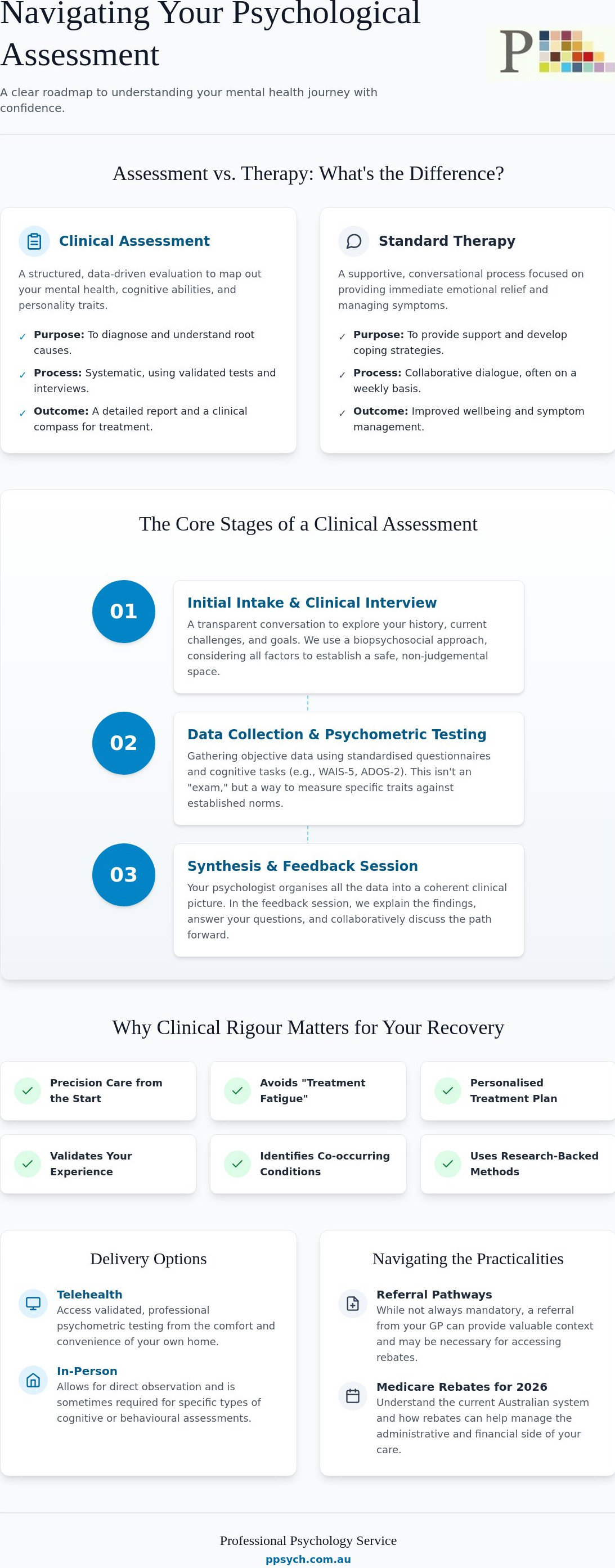
Many people arrive at their first appointment feeling unsure about what lies ahead. While a standard therapy session focuses on providing immediate support and emotional relief, the psychological assessment process serves a different, more structured purpose. It's a systematic evaluation designed to map out an individual’s mental health, cognitive abilities, and personality traits. This process isn't about passing or failing; it’s a methodical way to gather specific data to answer a clinical question that therapy alone might not resolve.
The core goal is to shift the focus from merely managing symptoms to achieving a deep, root-cause understanding of your experience. Rather than treating anxiety as a standalone issue, an assessment might reveal underlying neurodivergence or a history of trauma that informs how that anxiety presents. The Psychological evaluation is a collaborative clinical investigation between patient and psychologist. It creates a shared language for your experiences, ensuring you feel seen and understood by your clinical team.
The Difference Between Screening and Formal Assessment
It's helpful to view screening tools as a "first look" at a person's wellbeing. You might have completed a short questionnaire at a GP clinic or online that suggests you’re experiencing high levels of stress. While these are useful indicators, they don't provide the diagnostic depth required for a complex treatment plan. A full assessment is a deep dive. It's particularly vital when identifying complex trauma or co-occurring conditions, such as when ADHD and an eating disorder present together. We use evidence-based methodology to ensure every finding is accurate and safe, providing a level of certainty that a simple consultation cannot offer.
This proactive approach to screening is also gaining traction internationally; for example, readyhealth.co.uk offers advanced health pods that allow for rapid, accessible health checks to provide a baseline for overall wellbeing.
Why Clinical Rigour Matters for Your Recovery
Precision is the key to effective care. When a diagnosis is accurate from the start, it prevents "treatment fatigue," which often happens when patients spend months in therapy that doesn't quite hit the mark. By using validated Australian psychological instruments, we ensure the results are relevant to your specific context and culture. This clinical rigour provides the stable anchor you need during a vulnerable time. Once the assessment phase is complete, the focus naturally shifts into a tailored treatment plan. This transition ensures that the path forward is not based on guesswork, but on a research-backed understanding of your unique psychological profile.
The Core Stages of a Clinical Psychological Assessment
The journey toward understanding your mental health is rarely a single event. Instead, the psychological assessment process is a cumulative experience that typically unfolds over several sessions. This steady, methodical approach ensures your psychologist can look for consistent patterns across your personal history, current behaviours, and standardised test results. By moving through these stages intentionally, we build a comprehensive clinical picture that serves as a stable foundation for your future wellbeing.
Initial Intake and Clinical Interview
Everything begins with a transparent conversation. During the initial intake, we explore your history, the challenges you’re currently facing, and the specific outcomes you hope to achieve. We utilise a biopsychosocial approach, which means we look at the whole person by considering biological, psychological, and social factors. This stage is about establishing a safe, non-judgemental space where you can speak openly, knowing your story is being heard with professional care and quiet confidence.
Data Collection and Psychometric Testing
Once we have established the context of your life, we move into gathering objective data. This often involves standardised questionnaires or cognitive tasks, such as the WAIS-5 for cognitive functioning or the ADOS-2 for autism assessments. Understanding psychological testing and assessment helps clarify that these tools aren't "exams" but ways to measure specific traits against established norms. Your clinician also gathers observational data, noting non-verbal cues and reviewing collateral information like school reports or previous medical records to ensure no detail is overlooked.
Synthesis and the Feedback Session
After the data is collected, your psychologist organises these complex pieces into a coherent clinical picture. This leads to the final stage, where the feedback session is often the most vital part of the entire journey. We don't simply hand over a document; we sit with you to explain what the findings actually mean for your daily life. Together, we use this information to set practical goals for the next phase of your care. If you are seeking clinical psychology for adults, this session ensures your treatment is precisely targeted to your unique needs, providing the clarity required to move forward with purpose.
Telehealth vs. In-Person: Adapting the Assessment Process for Online Delivery
Telehealth psychology has revolutionised access to specialist assessments across Australia. For many, the traditional need to travel to a metropolitan clinic was a significant barrier to care. Now, clinical interviews and many psychometric tests are validated for remote delivery. This shift ensures that the psychological assessment process remains robust and accurate, regardless of your physical location. While the medium has changed, the core clinical logic remains identical. Professional Psychology Service maintains the same ethical standards online as in-clinic.
Benefits of the Telehealth Assessment Approach
Choosing a remote evaluation offers several practical and emotional advantages. Accessing care from your own home provides a sense of security that a clinical office sometimes lacks. This is particularly helpful for families who might otherwise face hours of travel. Key benefits include:
Removing geographic barriers: You can access national expertise without the need for extensive travel, whether you are in a regional town or a city centre.
Reduced anxiety: Familiar surroundings often lead to more authentic and relaxed responses during testing. When you feel safe in your own space, your baseline stress levels are lower.
Scheduling flexibility: Remote sessions eliminate travel time and the logistical stress of parking and traffic. This makes it easier to fit the evaluation into a busy work or school week.
Ensuring Validity in a Remote Setting
Maintaining the integrity of the psychological assessment process requires a few specific preparations. To ensure your results are valid, you will need a stable internet connection and a private, quiet space where you won't be interrupted. A high-quality camera and microphone are also essential. These tools allow your psychologist to observe non-verbal cues clearly, which is a vital part of the clinical observation. Our clinicians use standardised tools that have been specifically adapted for digital use. These adaptations are research-backed to ensure they don't lose accuracy when administered via a screen.
However, there are times when an in-person session remains the preferred clinical choice. This might occur with certain types of physical cognitive tasks or if a client has specific sensory needs that are better managed in a controlled clinic environment. Your psychologist will discuss these options with you during the intake phase. This ensures the chosen format is the most effective for your specific journey and provides the most reliable data for your future treatment.
Navigating Practicalities: Referrals, Medicare, and Preparation
Understanding the administrative side of mental health care often helps lower the initial barrier to entry for new clients. While the psychological assessment process involves deep clinical work, the logistics of getting started are just as important for your peace of mind. The Australian healthcare system provides several pathways to make these professional services more accessible and manageable. While a referral isn’t always required to see a private psychologist, it is essential if you wish to claim Medicare rebates for your sessions.
The Mental Health Treatment Plan and GP Referrals
To access financial support, your first step is usually a conversation with your GP. You can request a long appointment to discuss a Mental Health Treatment Plan. This plan allows you to access rebates for up to 10 individual sessions per calendar year. As of 1 July 2026, the Medicare rebate for a 50-minute session with a clinical psychologist is $149.05. It is helpful to understand that while these rebates apply to clinical consultations, they typically do not cover the costs associated with formal medico-legal reports. These reports require extensive additional work beyond the face-to-face assessment hours and are billed differently to standard therapy sessions.
How to Prepare for Your First Assessment Session
Proper preparation ensures you get the most value from your clinical hours. We recommend collating any previous reports from school, medical specialists, or past therapists. Your history is a vital piece of the puzzle; it provides context that helps your psychologist see the full picture of your development and current challenges. It is also completely normal to feel nervous or feel like you don't have all the answers. The psychological assessment process is designed to uncover those answers alongside you, not to catch you out or judge your experiences. Before your session, check your technology if you are using telehealth, or ensure you have the correct address for the clinic centre to avoid last-minute travel stress.
If you are ready to take the first step toward clarity, you can learn more about our clinical psychology for children and adults to see how we can support your specific needs and guide you through the next stages of your care.
Integrating Assessment Results into Your Personal Treatment Plan
Think of the psychological assessment process as the compass that guides your journey through therapy. Without this initial mapping, treatment can sometimes feel like wandering without a clear destination. By identifying the specific nuances of your mental health, evidence-based treatments like CBT or trauma-informed care become far more effective because they are precisely targeted to your needs. The final report isn't just a summary of the past; it serves as a baseline to measure your progress as you move toward your goals. Professional Psychology Service views assessment as the start of a long-term partnership focused on your sustained wellbeing.
From Diagnosis to Actionable Strategy
The true value of an assessment lies in its ability to move beyond labels. While a diagnosis provides a helpful framework, the real work involves using those results to build practical life skills and resilience. For example, understanding the specific triggers of your anxiety allows your psychologist to tailor a strategy that fits your daily routine. These insights are also invaluable when coordinating care with other professionals. Sharing results with GPs or schools ensures that everyone in your support network is working from the same evidence-based foundation. In this phase, your psychologist acts as a compassionate guide, helping you translate clinical data into a clear plan for what comes next.
Reviewing and Updating the Assessment Over Time
It is a common misconception that an evaluation is a one-off event. In reality, the psychological assessment process is dynamic. As you grow, learn new coping mechanisms, or face changing life circumstances, your treatment goals may need adjustment. We revisit your initial baseline to celebrate how far you have come and to identify any new areas that require focus. This ongoing review ensures your care remains relevant and high-quality. To maintain these standards, our clinicians engage in regular professional supervision, a practice that ensures our methods remain rooted in the latest established psychological research. This commitment to clinical rigour ensures that your treatment plan stays as flexible and resilient as you are.
Taking the First Step Toward Clarity and Recovery
Moving from a place of uncertainty to a structured path of recovery requires a clear map. You now understand that the psychological assessment process is not a series of hurdles to clear, but a collaborative investigation designed to ensure your therapy is precisely targeted and effective. By navigating the practicalities of 2026 Medicare rebates and choosing a delivery format that suits your life, you've already begun the work of prioritising your wellbeing.
Led by Dr Claire Cashman, our team of clinical psychologists is registered with the Psychology Board of Australia and specialises in evidence-based trauma and PTSD care. We provide the stable anchor and professional expertise needed to translate complex clinical data into a compassionate, personalised treatment plan. This methodical approach ensures that every session you attend moving forward is rooted in a deep understanding of your unique psychological profile.
If you're ready to gain the insights necessary for long-term growth and resilience, we're here to guide you through each stage with quiet confidence and care. Book a clinical consultation with Professional Psychology Service today to begin your journey with a team dedicated to your progress. You don't have to navigate these challenges alone; a clearer future is within reach.
Frequently Asked Questions
How long does a full psychological assessment process usually take?
The psychological assessment process typically takes between three and six sessions to complete from start to finish. This timeframe allows for an initial intake interview, several data collection sessions, and a comprehensive feedback meeting. While individual needs vary, this methodical approach ensures your psychologist has enough time to synthesise complex information into a reliable clinical picture that truly reflects your experience.
Do I need a GP referral to start the assessment process?
You do not strictly need a GP referral to begin, but you must have one to access Medicare rebates. A Mental Health Treatment Plan from your doctor allows you to claim back a portion of the consultation fees for clinical sessions. If you are seeking an assessment for purely private or medico-legal reasons, you can book directly with us without seeing a GP first.
Is a psychological assessment the same as a psychiatric evaluation?
No, these evaluations serve different clinical purposes and are conducted by different professionals. A psychological assessment focuses on cognitive, emotional, and behavioural patterns using standardised testing and observation. In contrast, a psychiatric evaluation is conducted by a medical doctor who primarily assesses for mental illness to determine if medication is required. Our service focuses on evidence-based psychological testing and treatment rather than medical prescriptions.
Can my child undergo a psychological assessment via telehealth?
Yes, many children can successfully complete the psychological assessment process via telehealth. Standardised tools like the Conners 4th Edition are validated for remote delivery, provided the child has a quiet space and a stable internet connection. Your psychologist will discuss your child's specific needs during the intake session to ensure that a remote format is clinically appropriate and comfortable for them.
Will I receive a written report after the assessment is finished?
Yes, a detailed written report is a standard outcome of every formal assessment we conduct. This document provides a clear summary of the tests performed, the clinical findings, and personalised recommendations for your future care. It serves as a vital clinical record that you can share with your GP, school, or other health professionals to ensure your support network is coordinated and informed.
What is the cost of a psychological assessment in Australia?
Costs vary across the country, but the APS National Schedule of Suggested Fees for 2025-2026 recommends a rate of A$318 for a standard consultation. For individuals with a valid referral, Medicare rebates as of July 2026 provide A$149.05 for clinical psychologist sessions. The total cost depends on the complexity of the required report and the number of sessions needed to gather all necessary data.
How do I explain the assessment process to my child so they aren’t scared?
You can explain the evaluation as a helpful way to understand how their brain learns and solves problems. Using terms like "brain puzzles" or "learning games" helps lower anxiety and makes the experience feel less like a school test. It is helpful to reassure them that there are no wrong answers and that the psychologist is a friendly guide who wants to help them feel happier.
Are the results of my psychological assessment confidential?
Yes, your results are strictly confidential and protected under Australian privacy laws and APS ethical guidelines. Your information cannot be shared with third parties, such as employers or schools, without your explicit written consent. The only exceptions are specific legal requirements or situations where there is a serious and immediate risk of harm to yourself or others.


Comments